Eduard P-51B Mustang Royal Hybrid Edition — 1:32 Scale
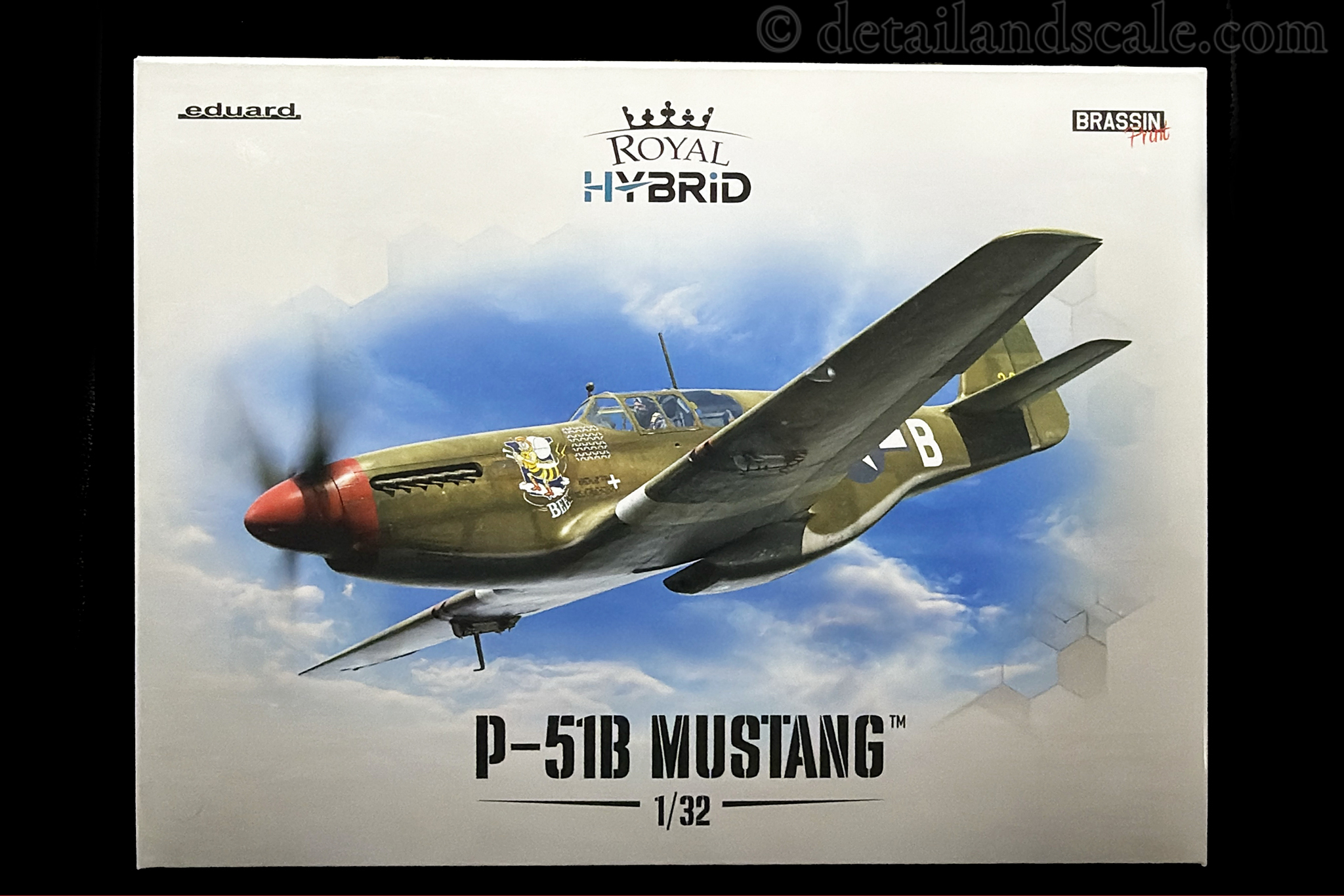
For nearly 60 years, scale modelers have long needed a good-quality injection molded 1:32nd scale P-51B Mustang. Eduard has finally answered this call. This new Mustang is also a kit that makes you think you might be looking at a new direction in plastic model manufacturing – and a change in how we build model airplanes. Eduard’s new 1:32nd scale P-51B just might be one of those kits. Let’s take a look.

The origin story of the “Cadillac of the Skies” is well known, and you can read more about it in Detail & Scale’s recent publication, P-51 Mustang in Detail & Scale, Part 1:The Allison-Engined Variants. Los Angeles-based North American Aviation developed the first variants of the legendary P-51 Mustang for the RAF in early 1940, and later, the USAAF became a major customer. These early Mustangs were powered by the Allison V-1710 powerplant. Contrary to uninformed lore, these were excellent aircraft, faster than any German or Japanese opponent down on the deck. Allison-powered Mustangs excelled in the air-to-air, reconnaissance, and ground attack roles – if they stayed below 15,000 feet. Yet, the air war (especially over Europe), was being fought at increasingly higher altitudes where early Mustang engine performance quickly degraded.
Development of a Mustang optimized for high-altitude flight began in late 1942 by both the British and Americans. It would be powered by a license-built Rolls-Royce Merlin engine produced by the Packard Motor Company. The new engine not only offered more speed and power above 15,000 feet, but it extended the P-51’s service ceiling to 33,000 feet (a 9,000-foot+ improvement). These new Packard Merlin engined Mustangs were known as the P-51B for the USAAF and the Mustang Mk. III for the British. The P-51C was a P-51B apart from some minor differences, with the -C suffix denoting that it was constructed at North American’s Dallas factory. Seventy-one P-51B/Cs were converted into F-6C reconnaissance aircraft.
P-51B/Cs happened to be at the right time and place when the strategic daylight bombing campaign over Europe and the Mediterranean was at a turning point in late 1943. The outstanding high-altitude performance and range of the new Mustangs provided a previously missing edge that helped force a tipping point in the air war in favor of the Allies. Across the Far East, P-51Bs and -Cs systematically ground down Japanese forces and were the most numerous American fighter aircraft in the China-Burma-India theater at war’s end. It is a long-held myth that the P-51B/C (and the earlier Allison-powered variants as well) were somehow “less than” or otherwise suffered from an underdeveloped potential when compared to the more widely recognized P-51D. This myth could not be farther from the truth. On paper, in the air, and in modern analyses, the P-51B/C held its own and made multiple unique contributions to the course of World War II that it only could have achieved. For deep dives on the history, design, variants, walk-around details, and much more, we direct the reader to Detail & Scale’s publication P-51 Mustang in Detail & Scale, Part 2: XP-51 Through P-51C.

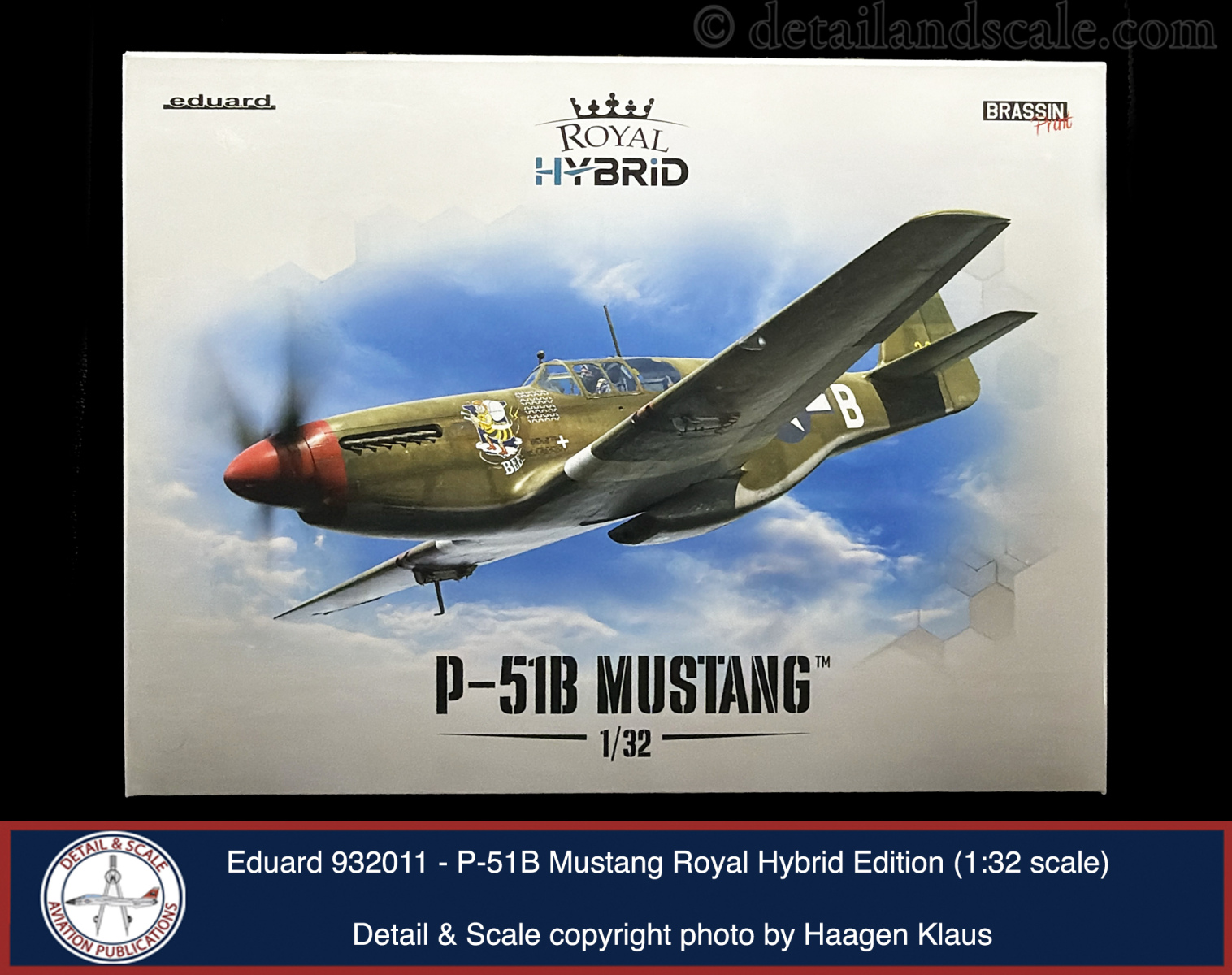
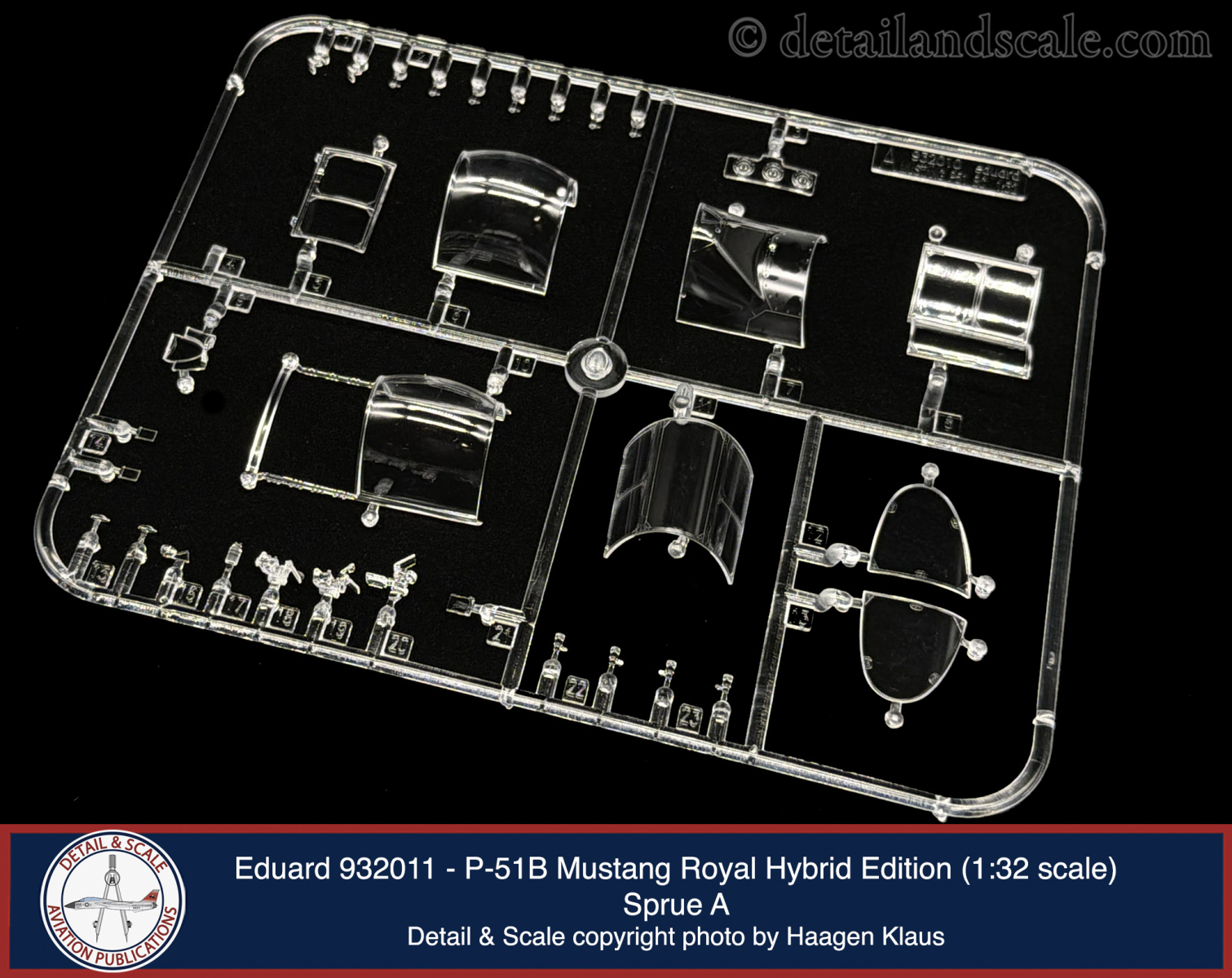
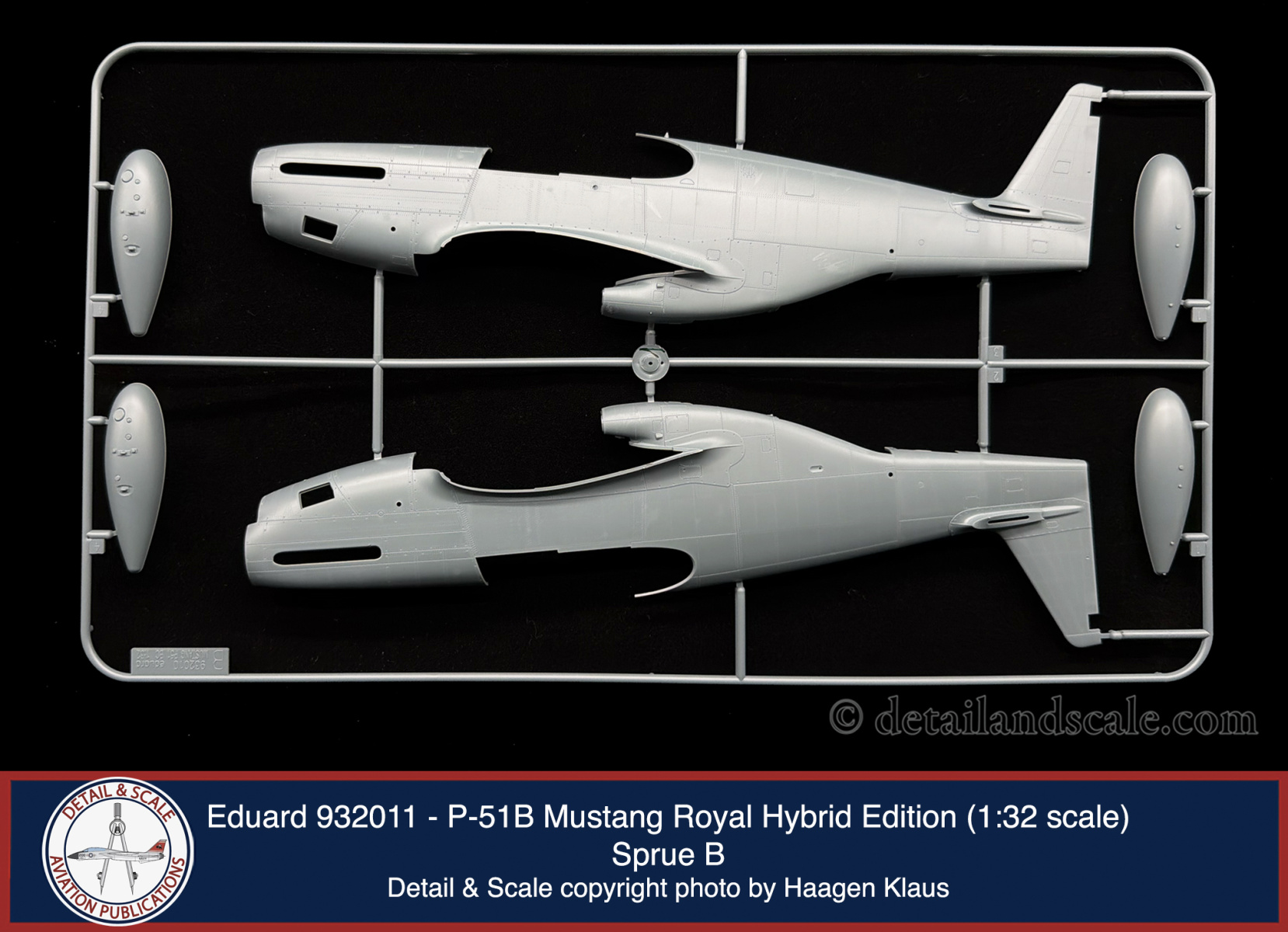
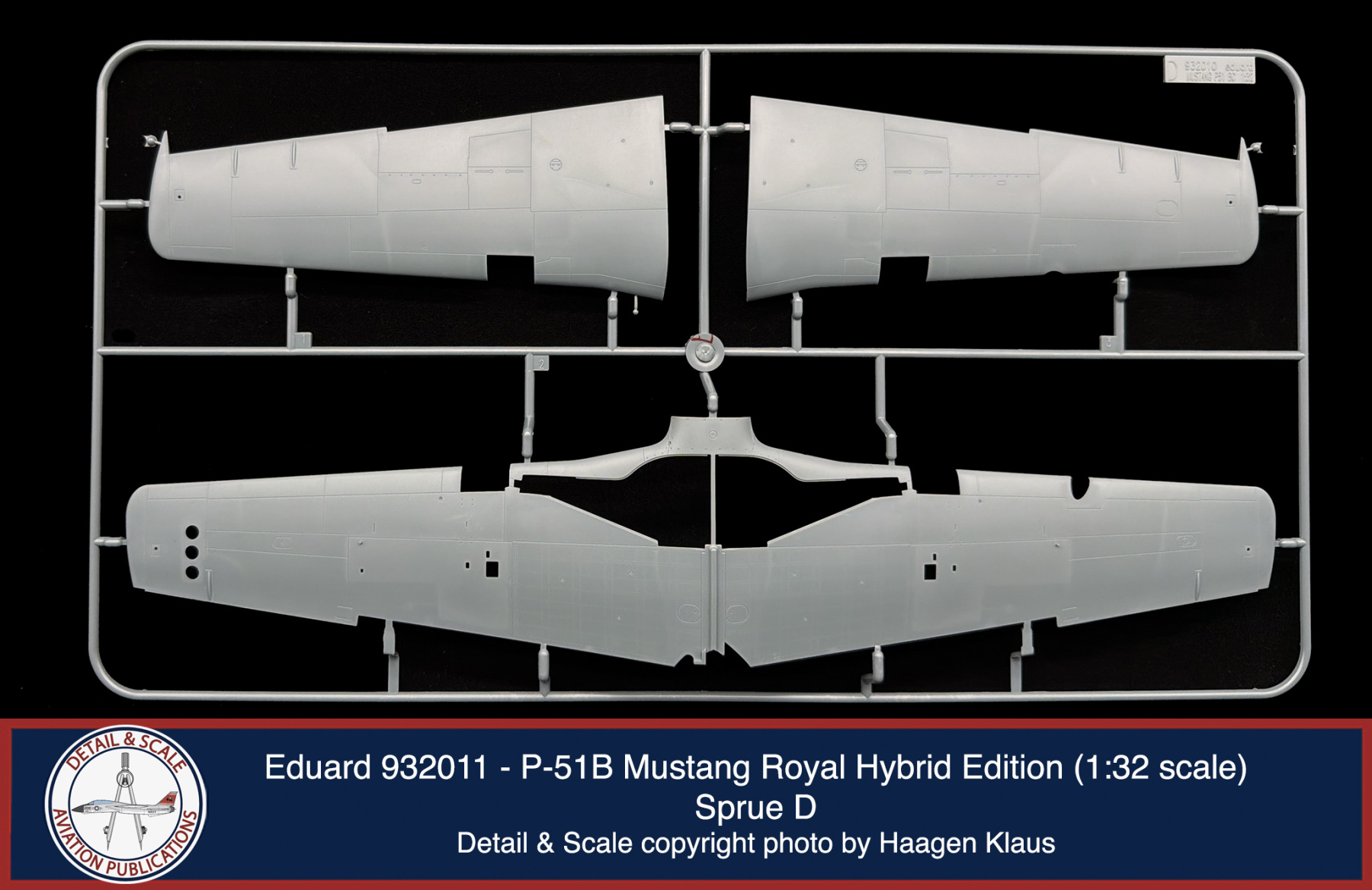
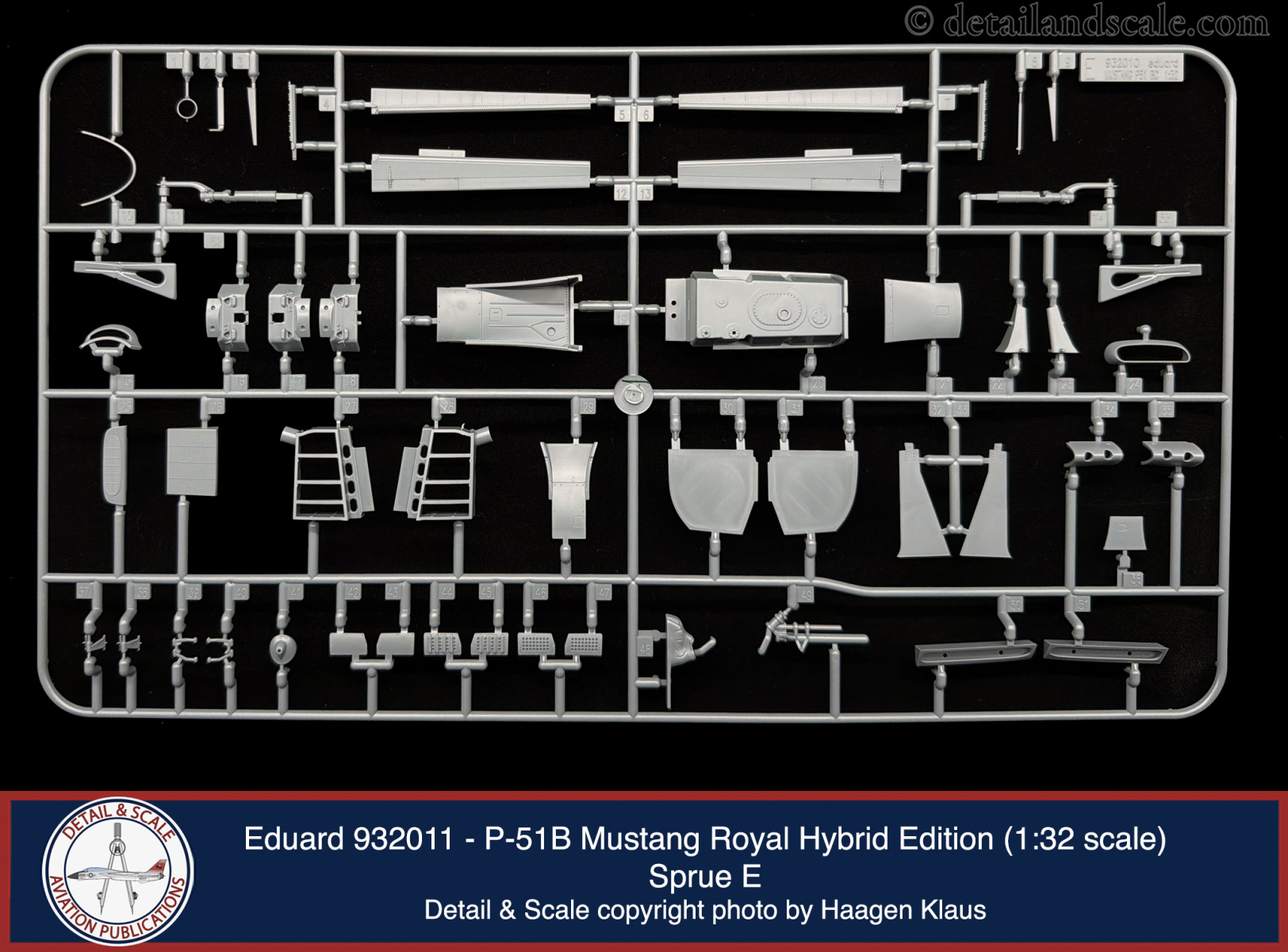
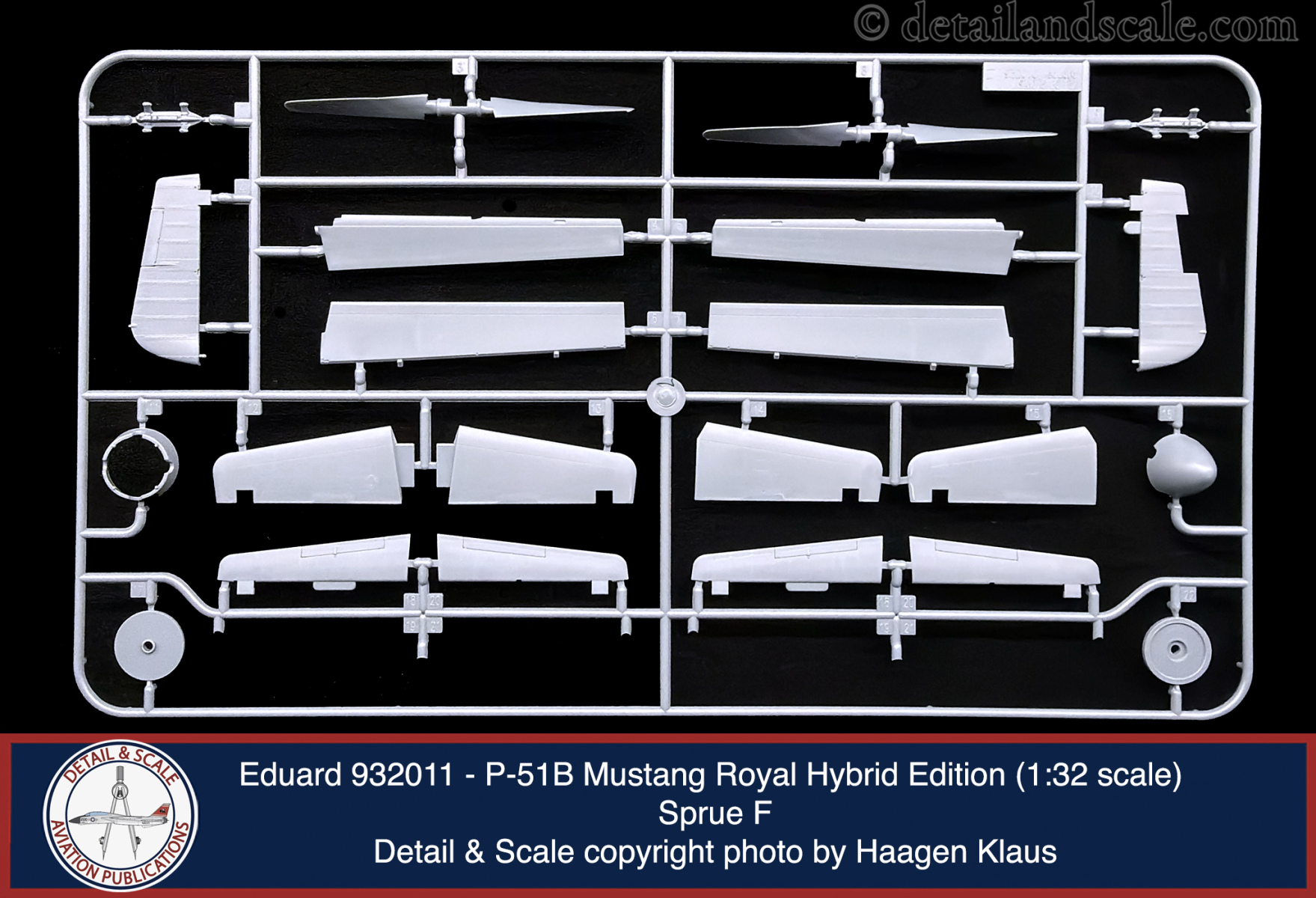
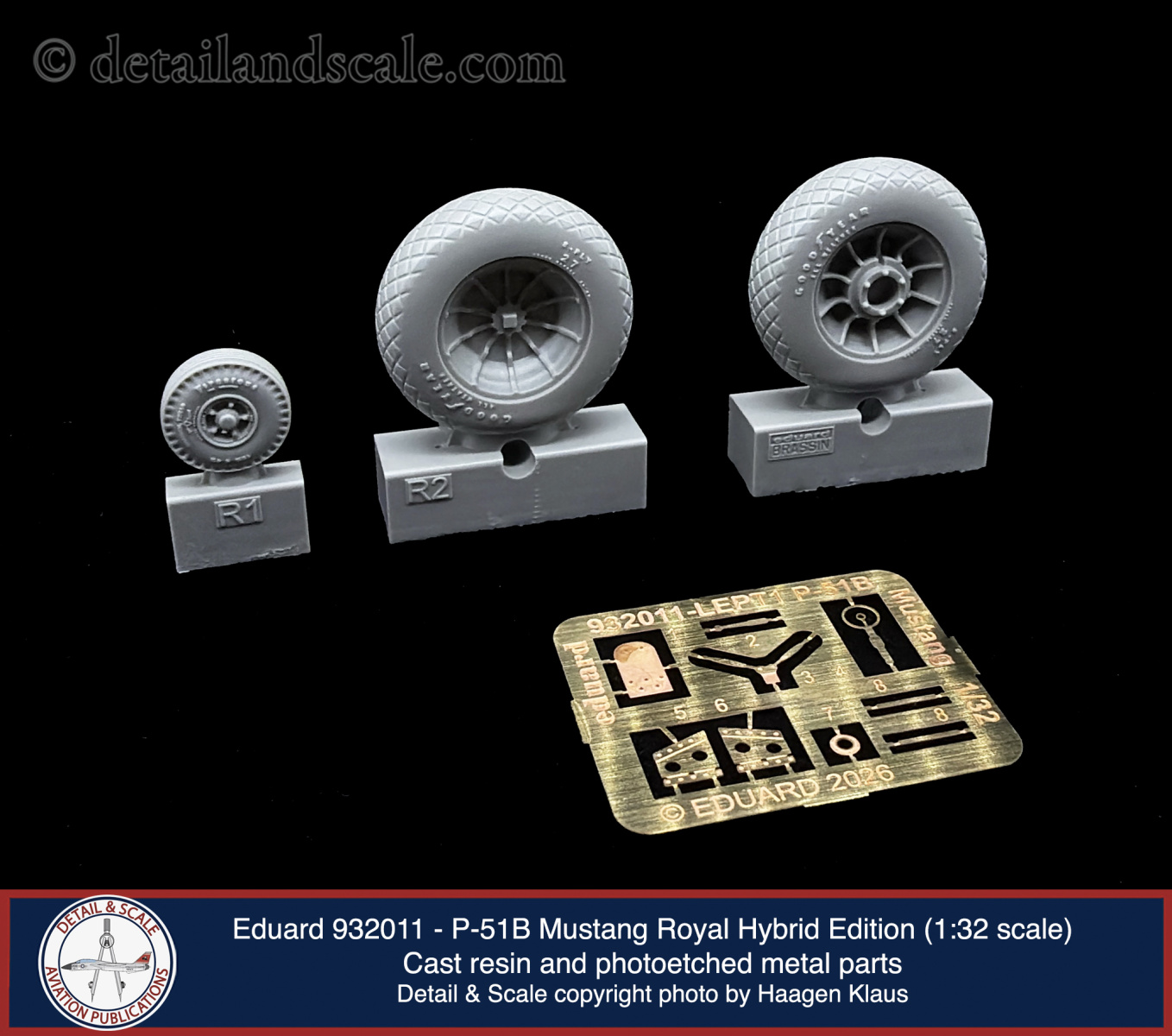
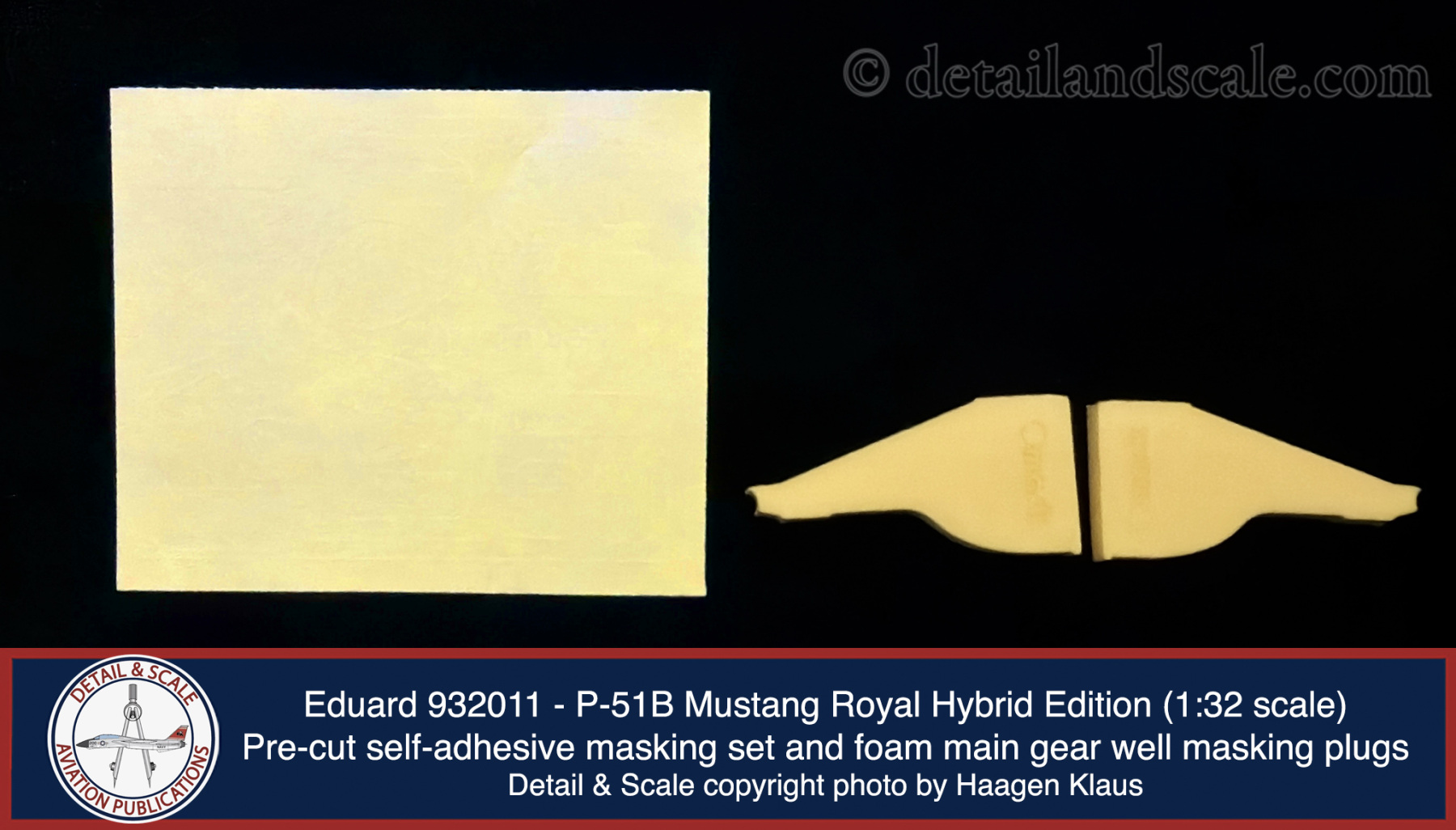
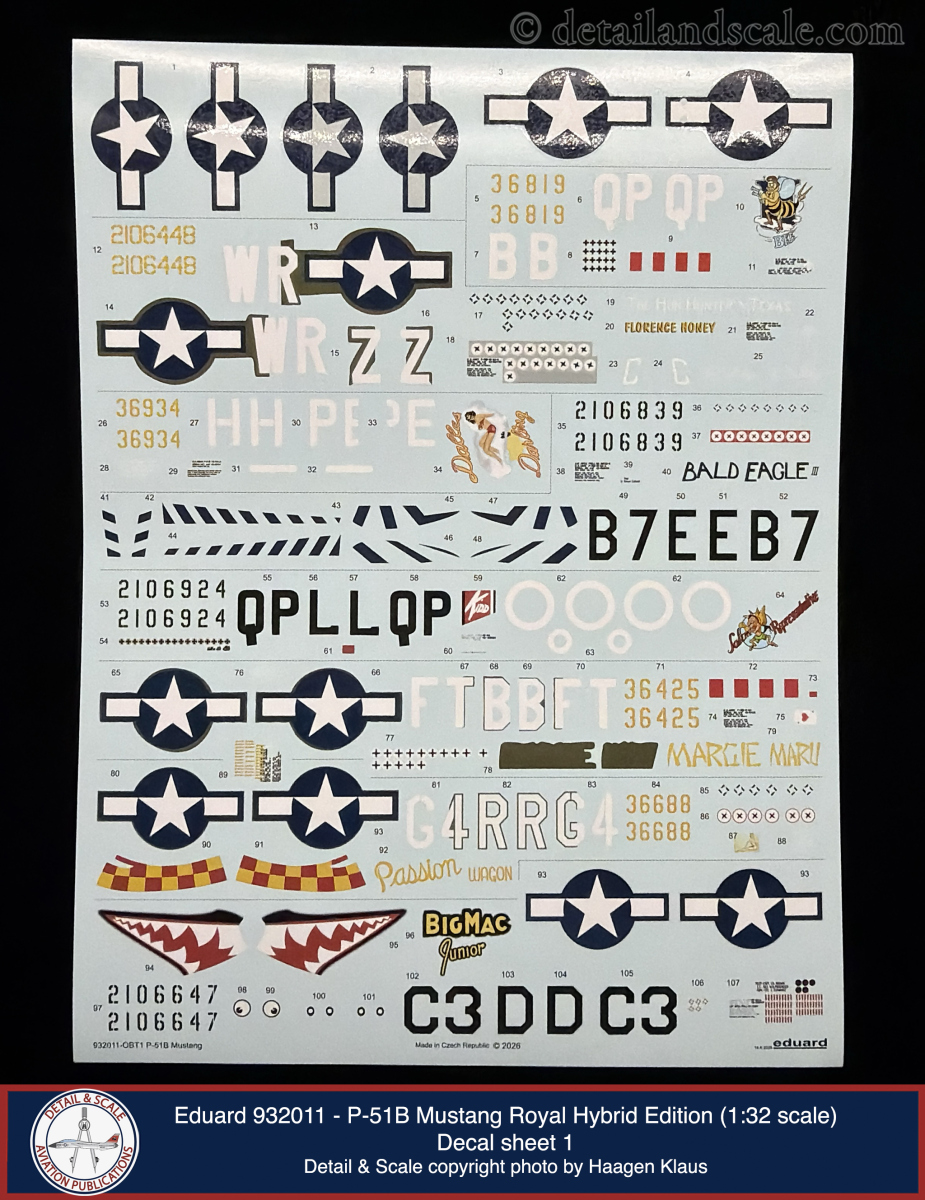
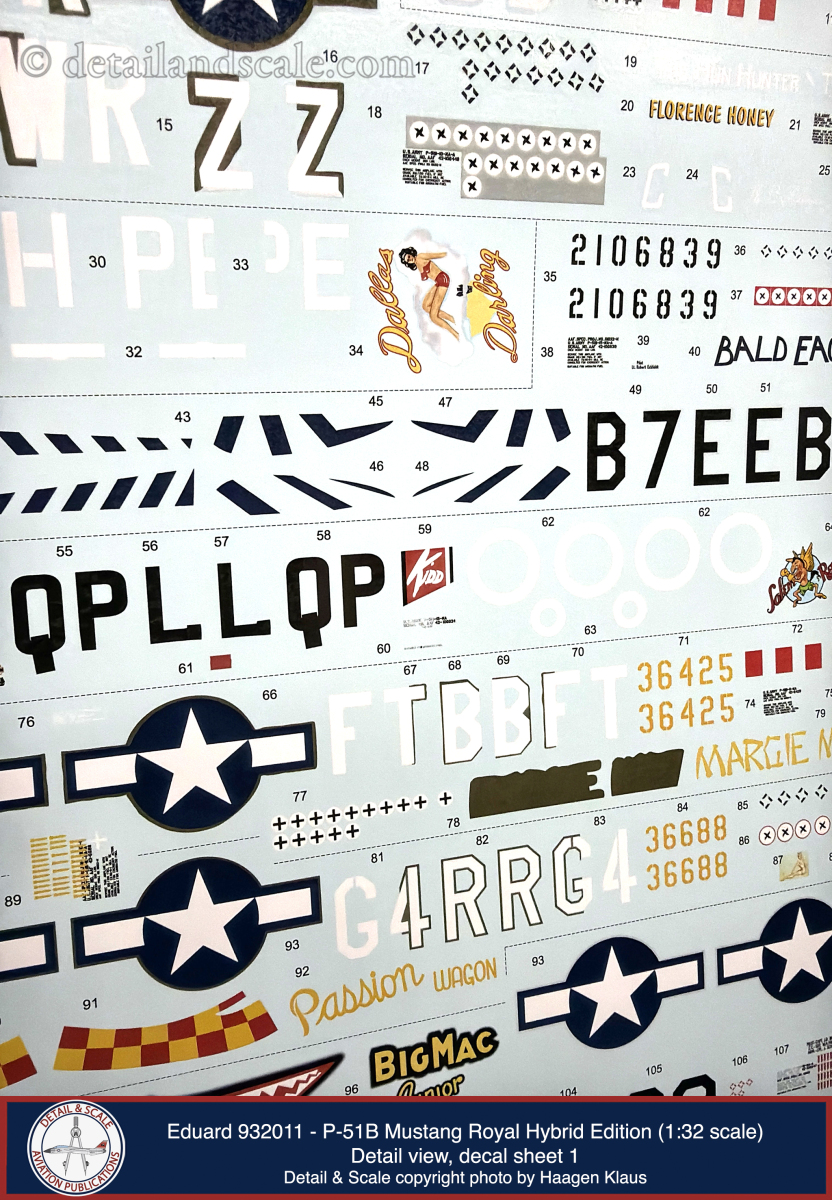
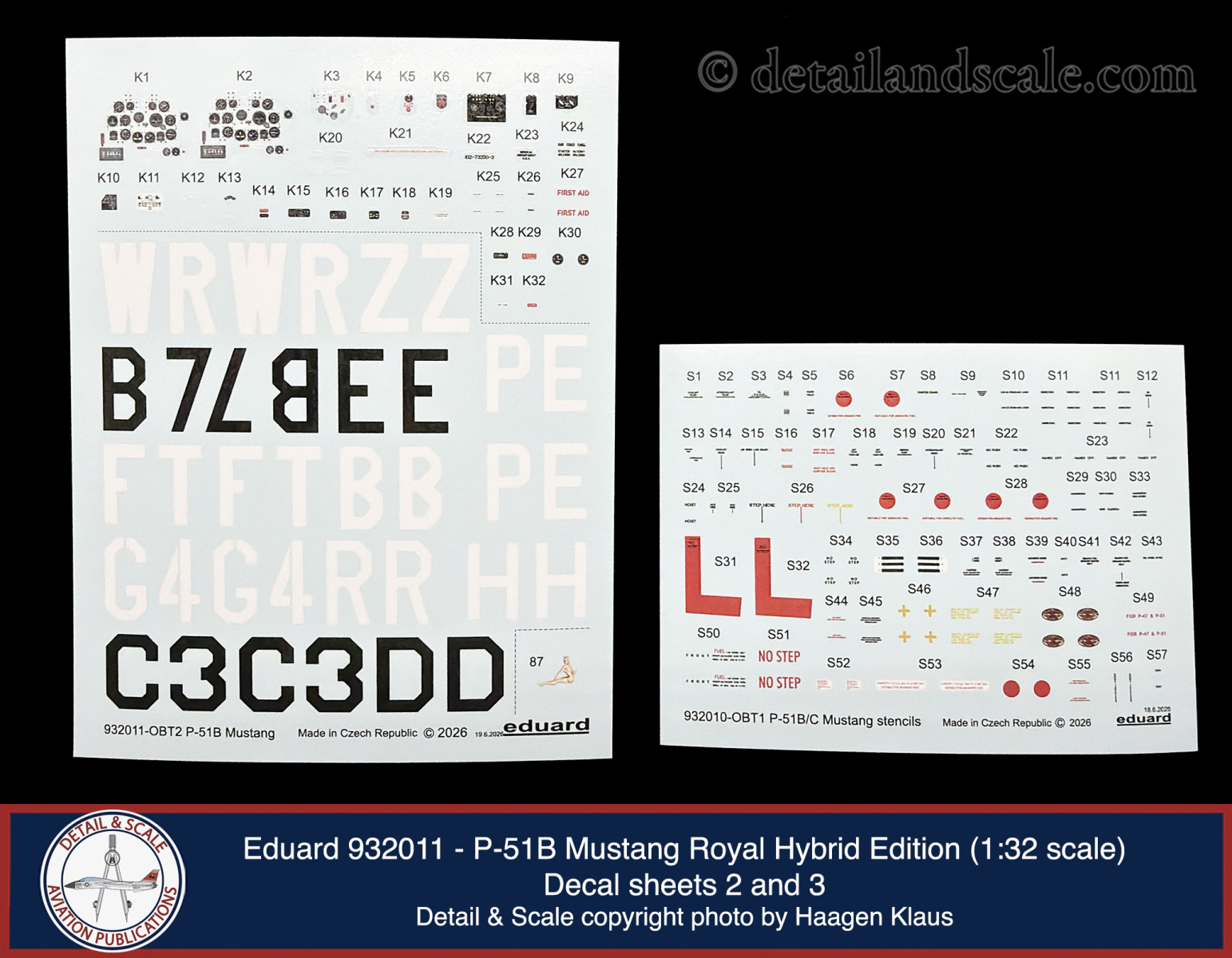
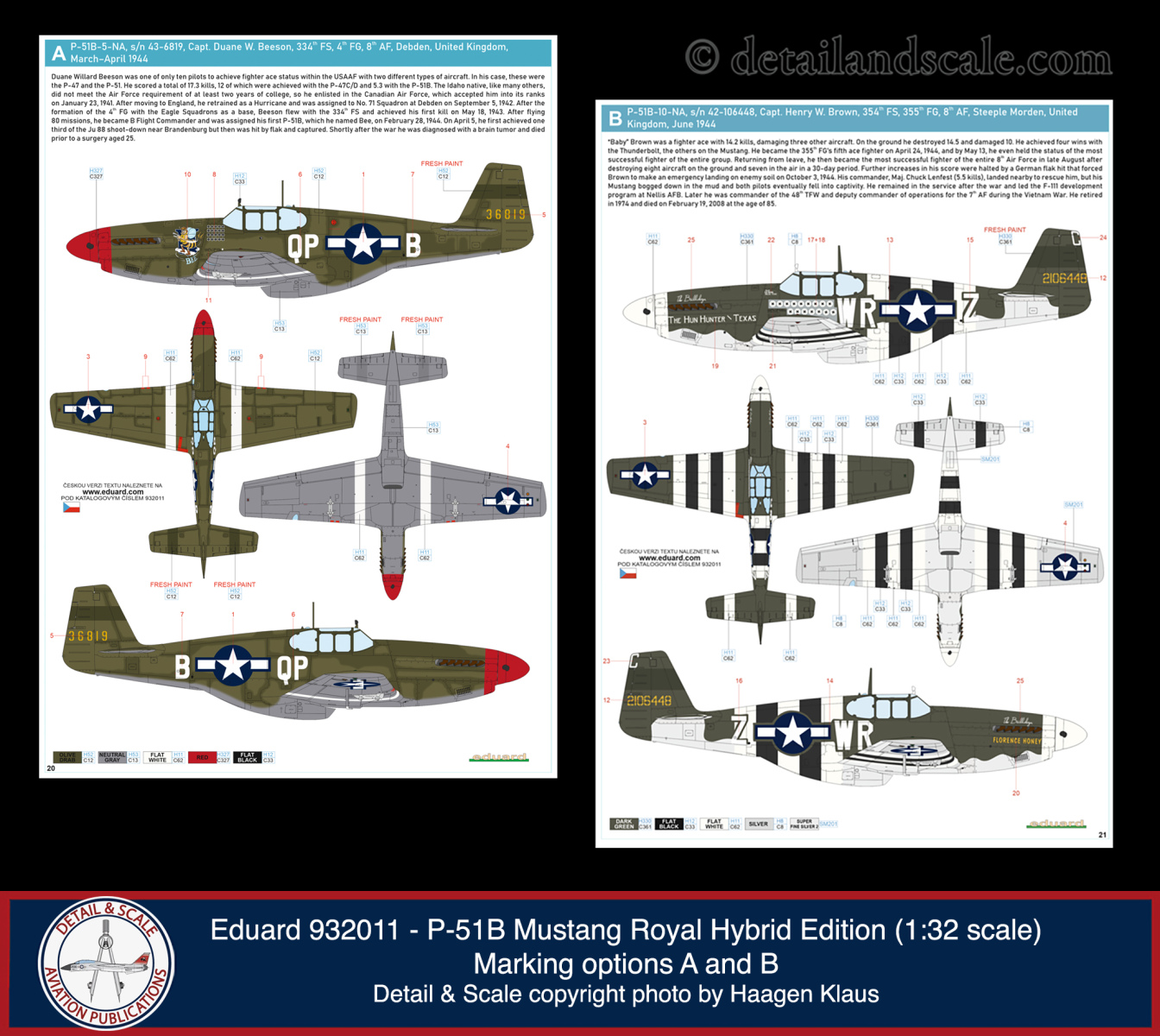
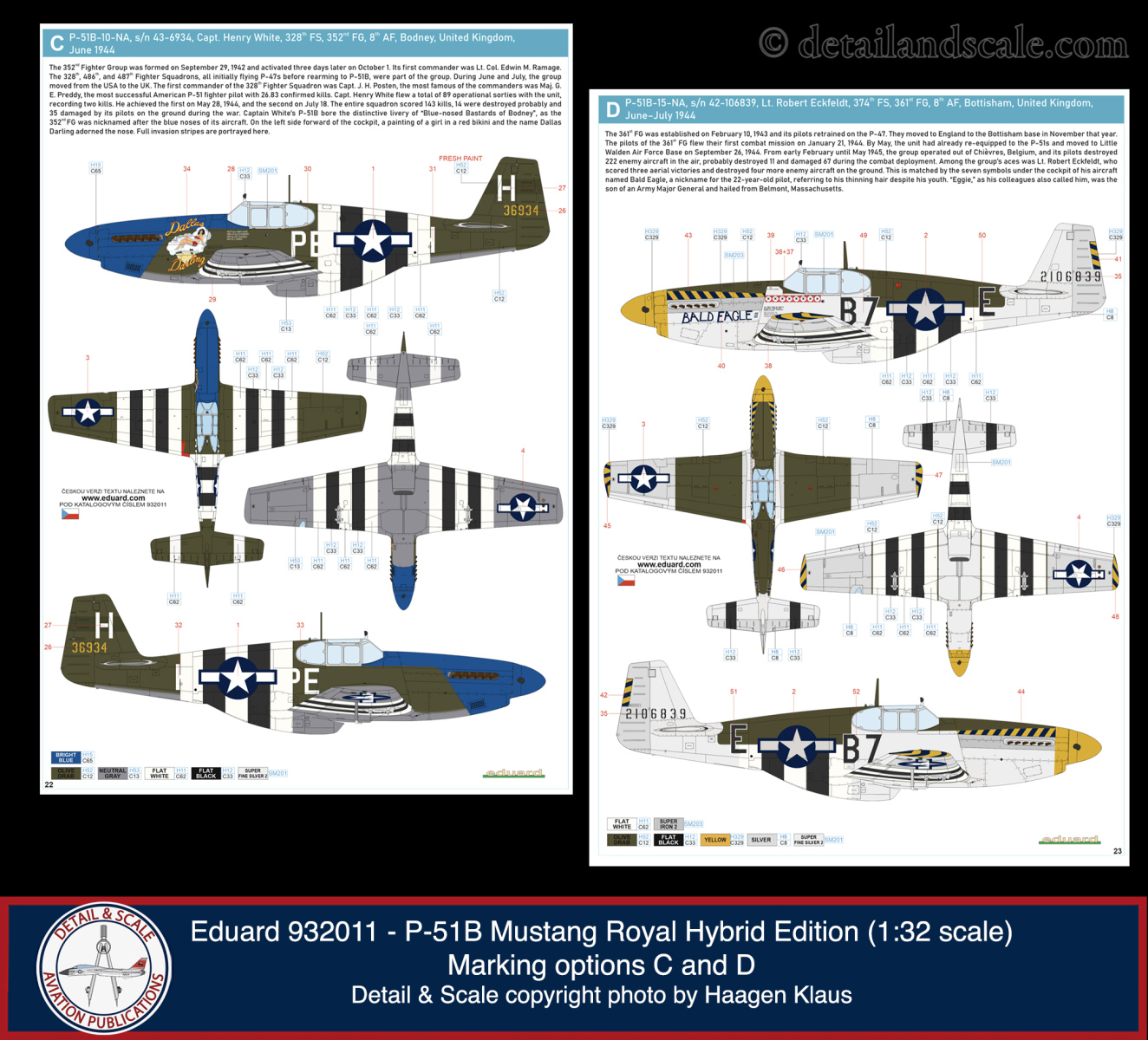
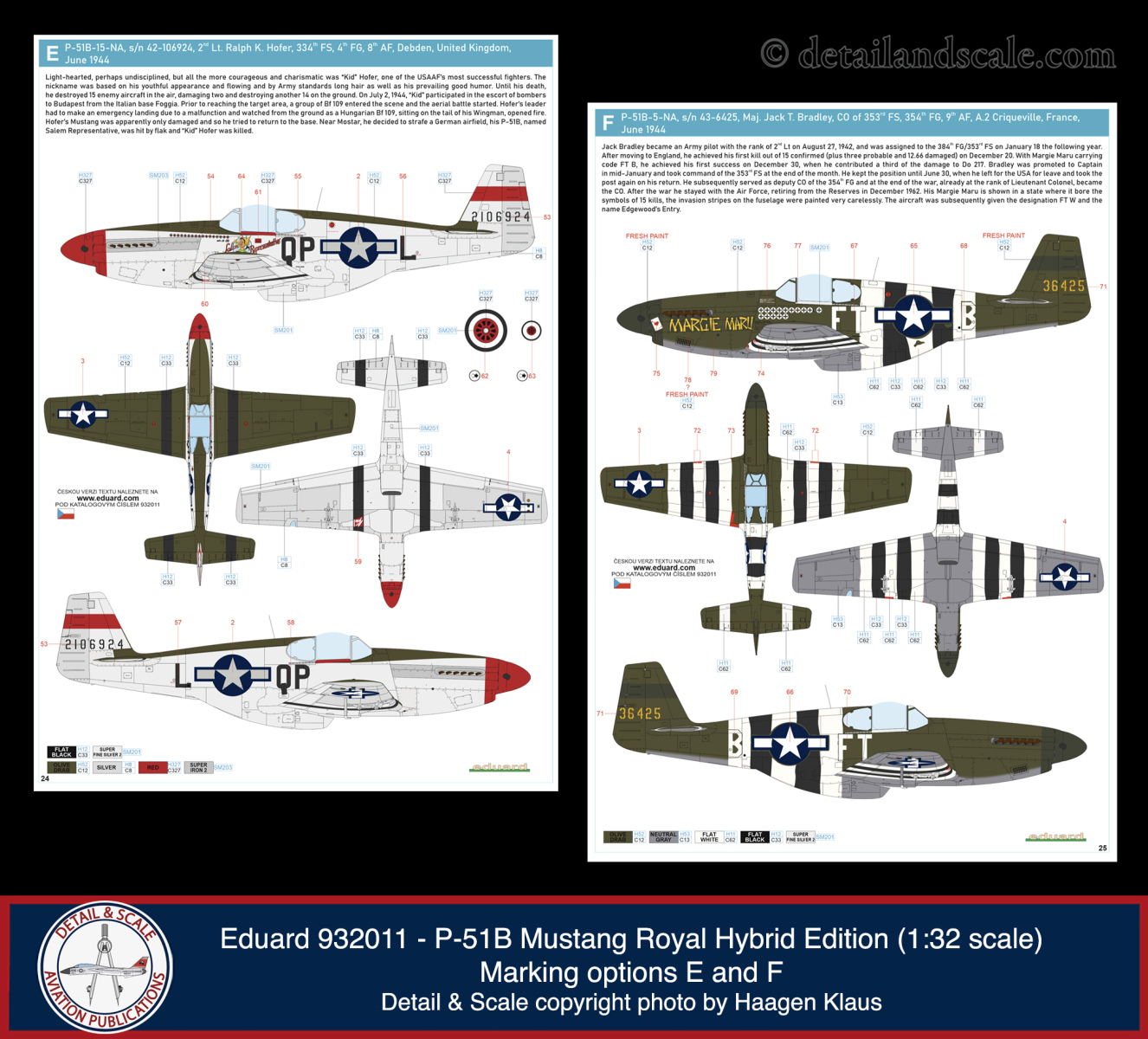
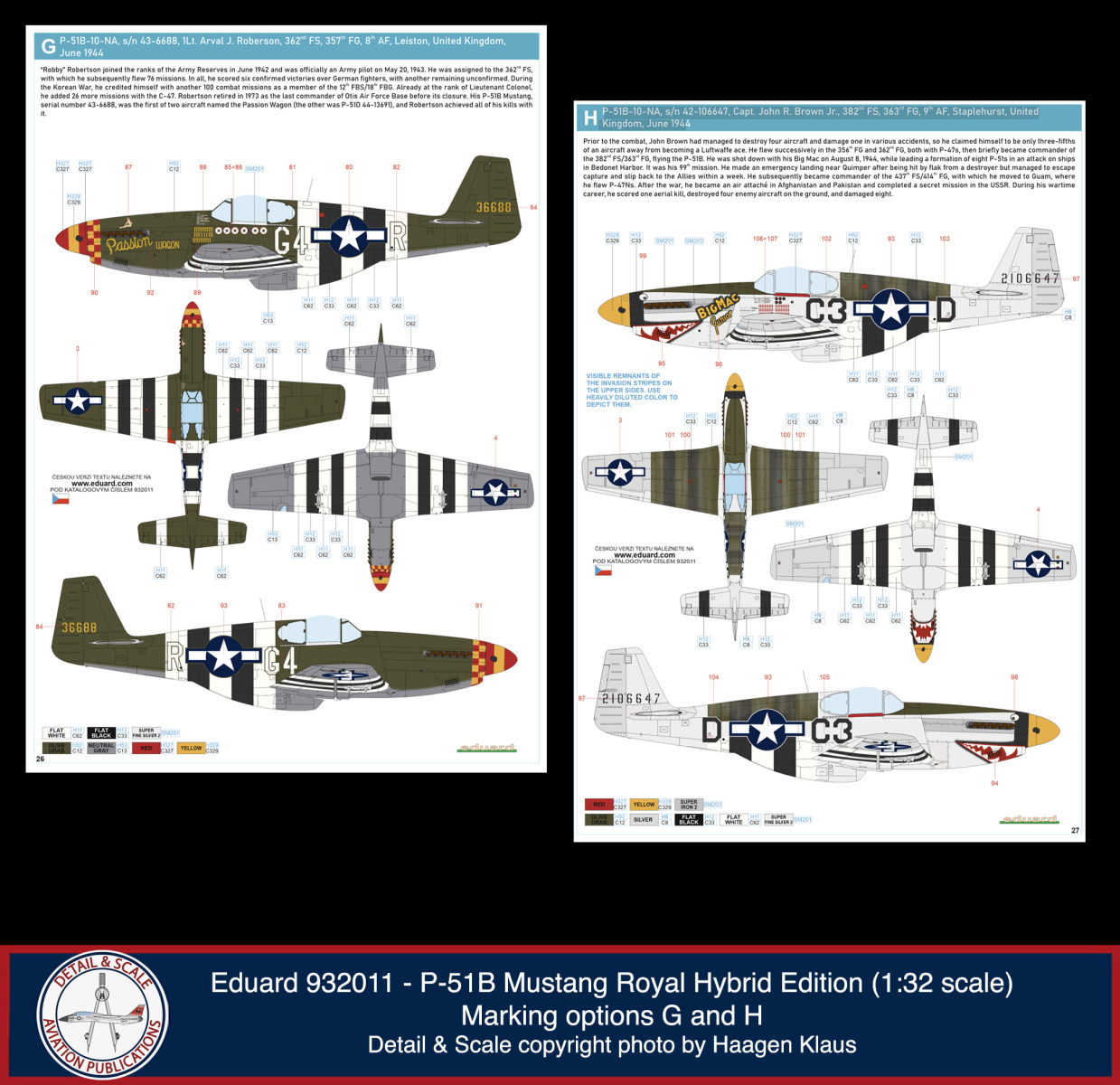
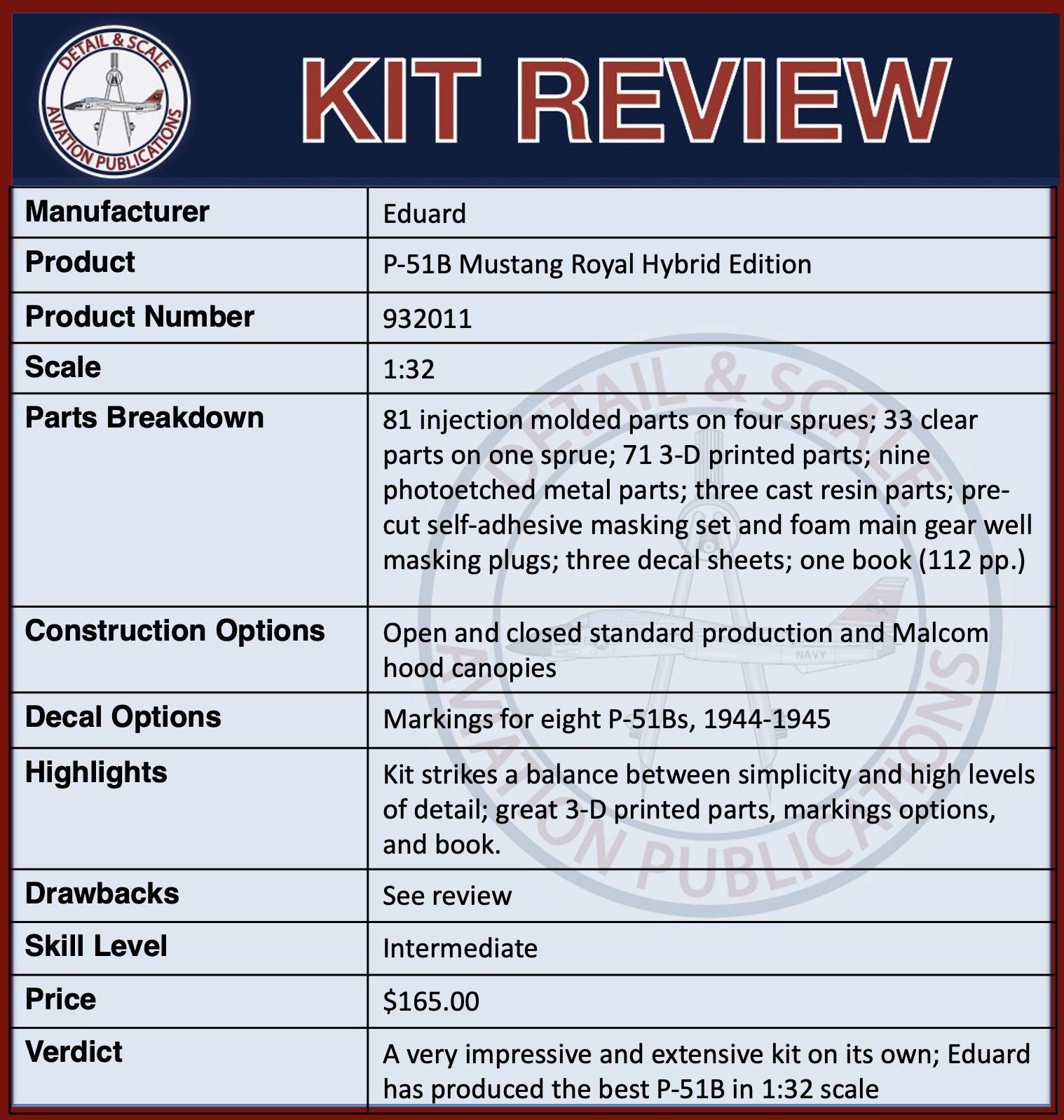
Eduard released their leadoff 1:32nd scale P-51B in the summer of 2026 as a Royal “Hybrid” Edition kit. It consists of 81 injection molded parts on four dark grey sprues (about nine parts go unused in this version of the kit), 33 clear parts on one clear sprue, nine photoetched metal parts on one fret, three cast resin wheels, 71 3-D printed parts, a pre-cut masking set for the windscreen and canopy, a set of foam masking plugs for the main gear wells, and three decal sheets. The Royal Hybrid Edition also comes with a pilot figure and a 112-page book on the P-51B’s technical development, combat operations, and the evolution of colors and markings. The very large main decal sheet covers the following aircraft:
- P-51B-5-NA, s/n 43-6819, “Bee,” flown by Capt. Duane W. Beeson, 334th FS, 4th FG, 8th AF, Debden, United Kingdom, March-April 1944
- P-51B-10-NA, s/n 42-106448, “The Hun Hunter of Texas/Florence Honey,” flown by Capt. Henry W. Brown, 354th FS, 355th FG, 8th AF, Steeple Morden, United Kingdom, June 1944
- P-51B-10-NA, s/n 43-6934, “Dallas Darling,” flown by Capt. Henry White, 328th FS, 352nd FC, 8th AF, Bodney, United Kingdom, June 1944
- P-51B-15-NA, s/n 42-106839, “Bald Eagle,” flown by Lt. Robert Eckfeldt, 374th FS, 361st FG, 8th AF, Bottisham, United Kingdom, June-July 1944
- P-51B-15-NA, s/n 42-106924, “Salem Representative,” flown by Lt. Ralph K. Hofer, 334th FS, 4th FG, 8th AF, Debden, United Kingdom, June 1944
- P-51B-5-NA, s/n 43-6425, “Margie Maru,” flown by Maj. Jack T. Bradley, CO of 353rd FS, 354th FG, 9th AF, A.2 Criqueville, France, June 1944
- P-51B-10-NA, s/n 43-6688, “Passion Wagon,” flown by 1st Arval J. Roberson, 362nd FS, 357th FG, 8th AF, Leiston, United Kingdom, 1944
- P-51B-10-NA, s/n 42-106647, “Big Mac Junior,” flown by Capt. John R. Brown Jr., 382nd FS, 363rd FG, 9th AF, Staplehurst, United Kingdom, June 1944
Strengths:
As we describe in the Modelers Section of P-51 Mustang in Detail & Scale, Part 2: XP-51 Through P-51C, 1:32nd scale has long been a wasteland when it comes to good, large-scale early Packard-Merlin powered Mustangs. Historically, there have been two choices: a very inaccurate and otherwise troubled 1969 molding of the P-51B/C/Mustang Mk. III by Revell, and a differently fraught 2007 P-51B/Mustang Mk. III by Trumpeter. Both kits have egregious problems. The bar was low, and it is easy to declare Eduard’s new P-51B has instantaneously eclipsed both, but by how much?
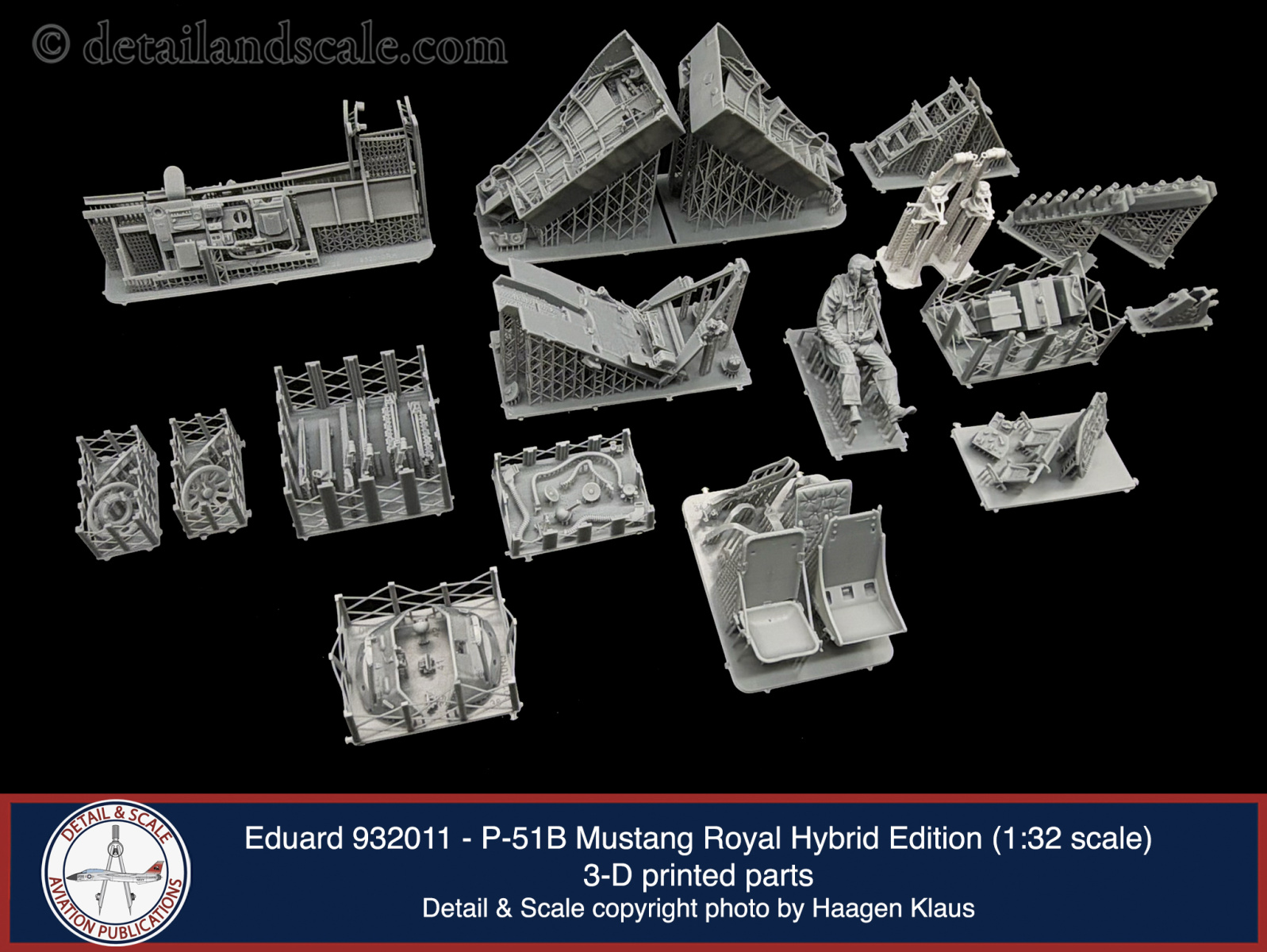
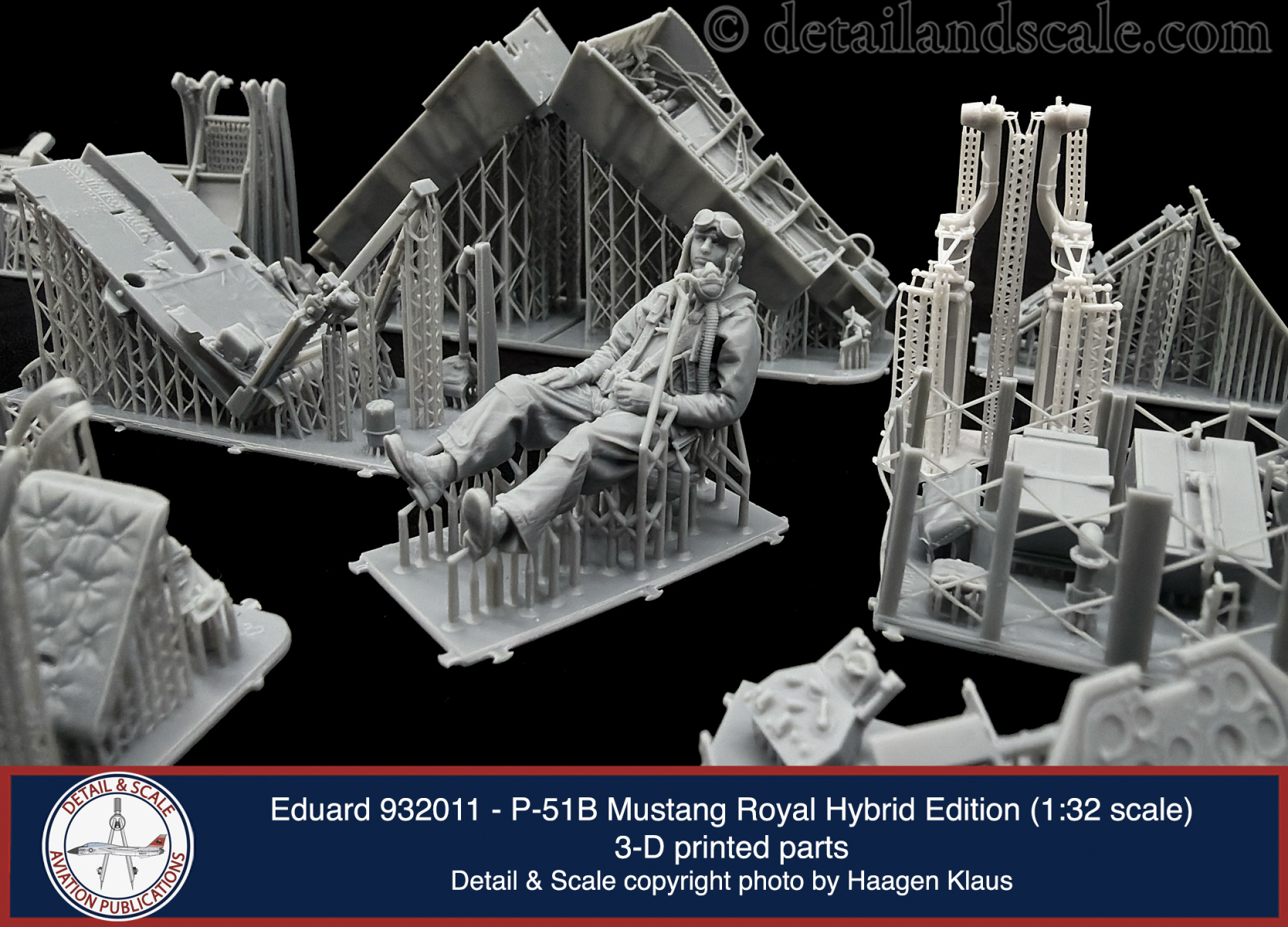
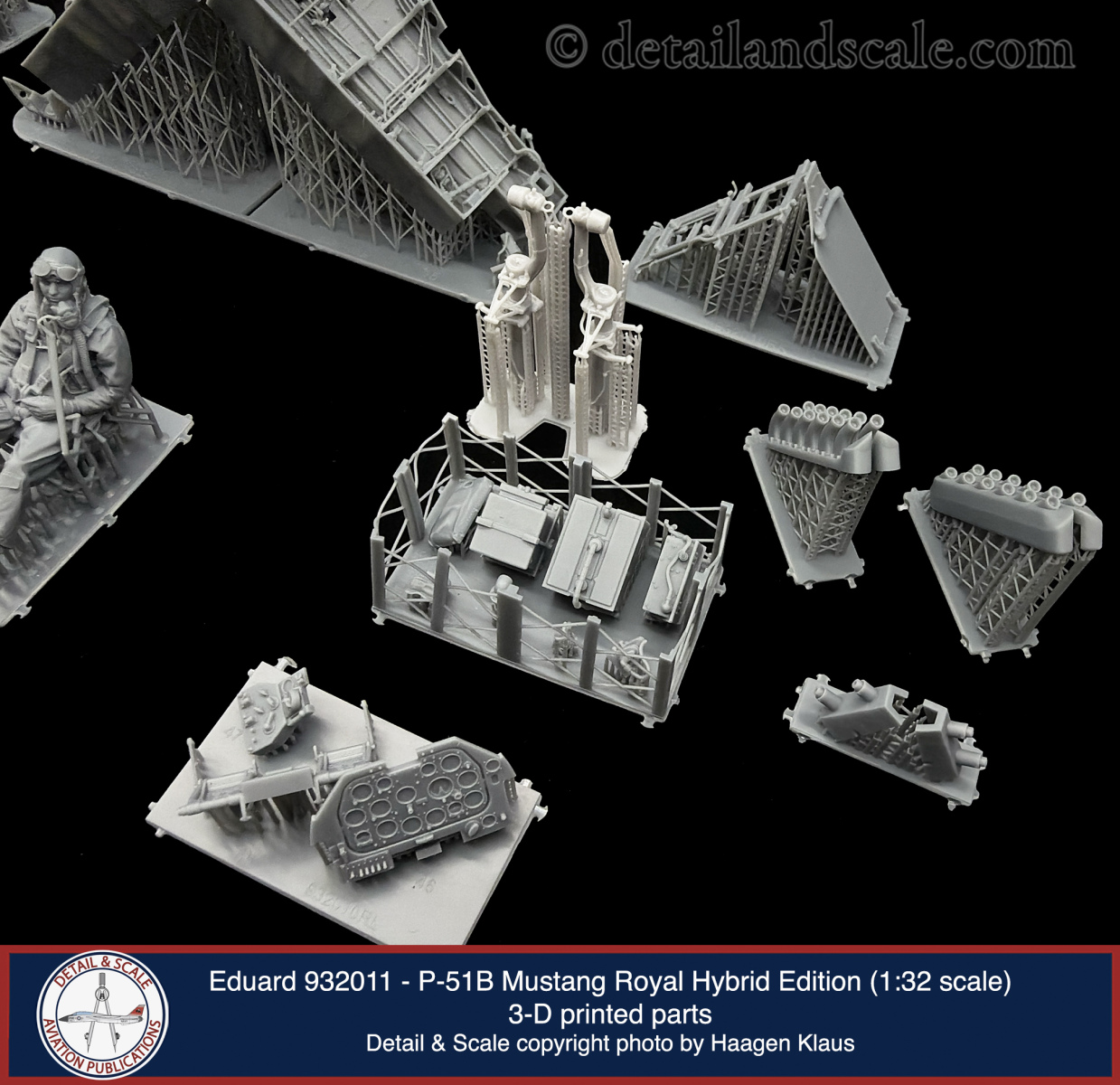
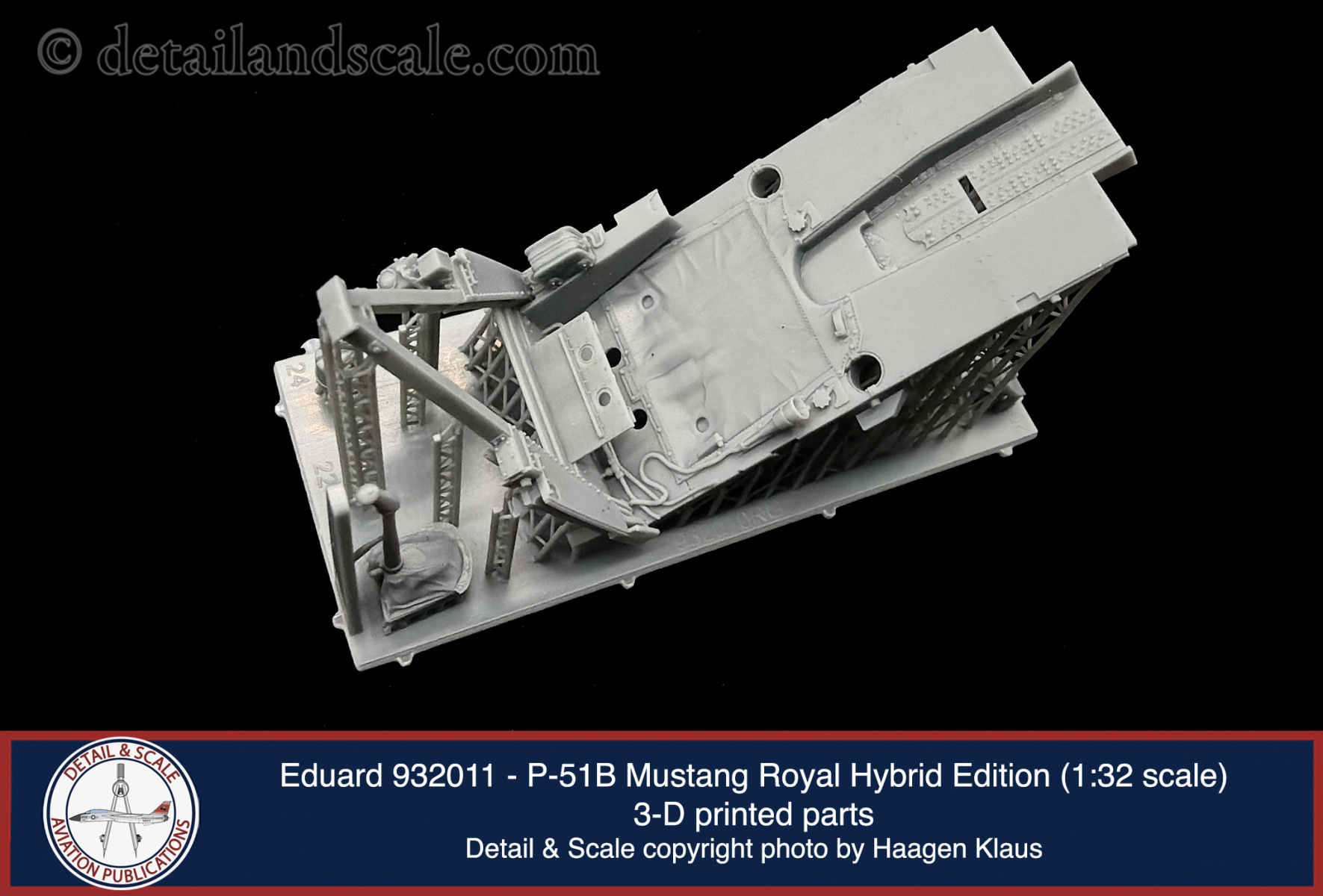
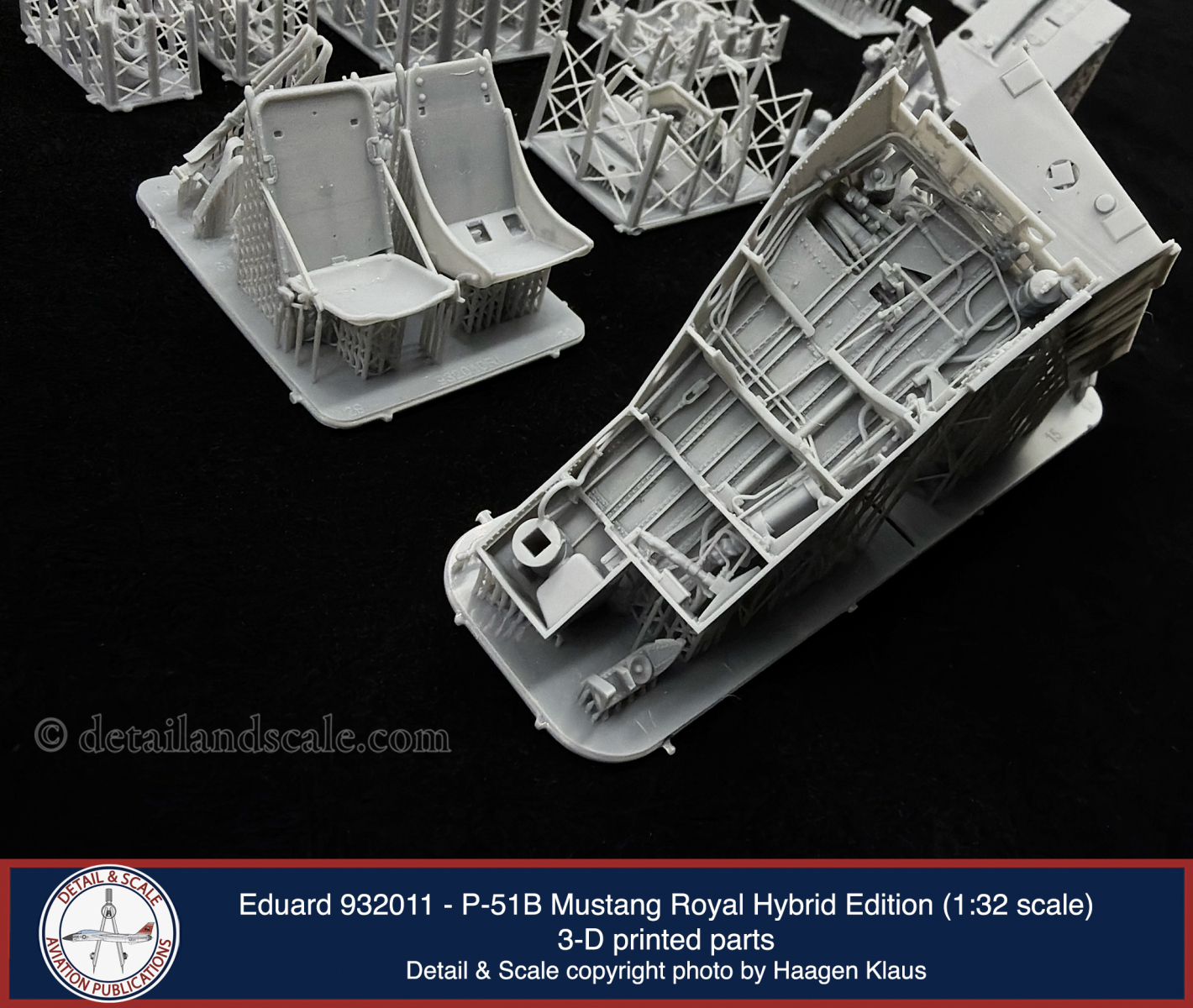
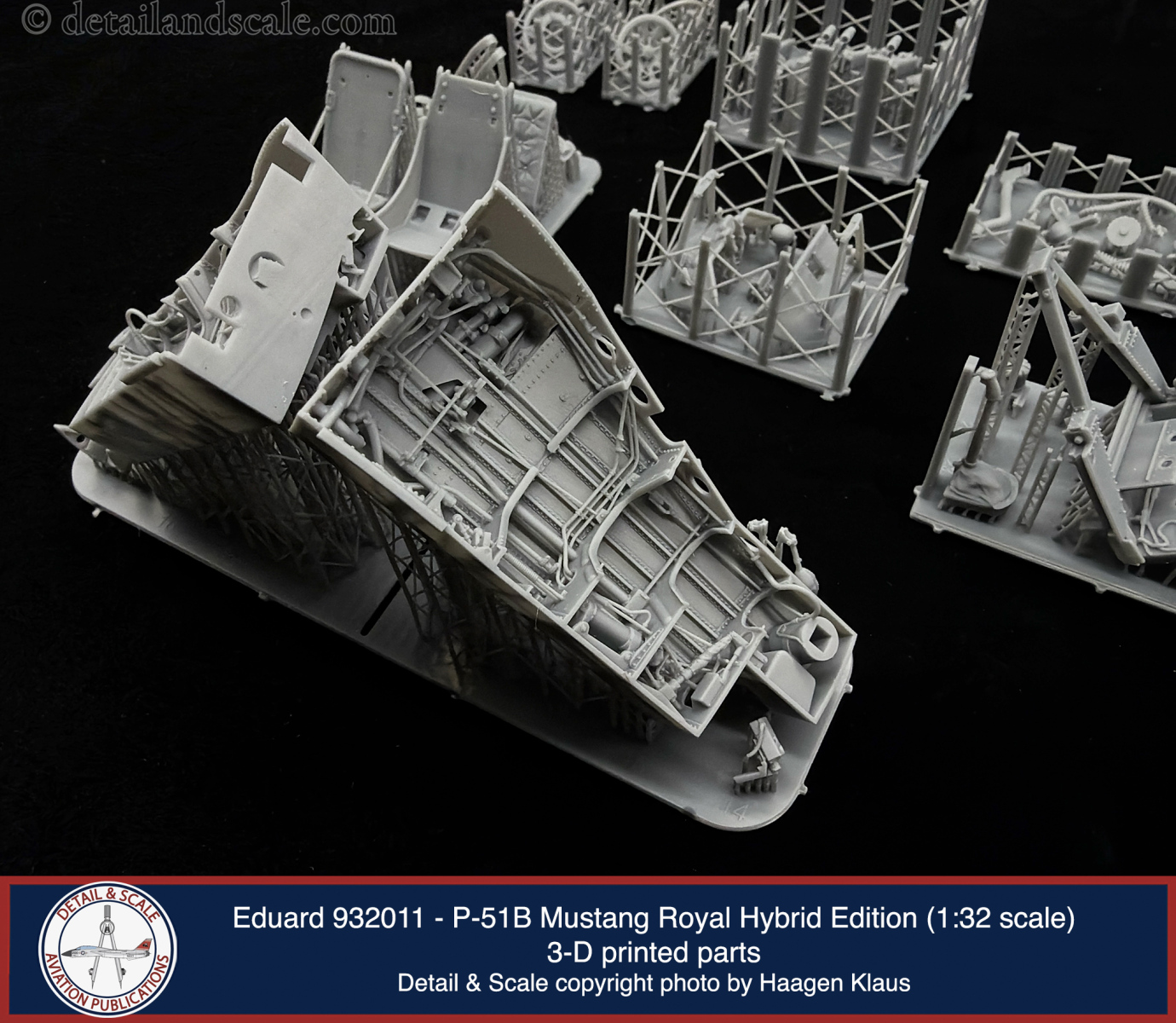
This kit is the first of Eduard’s Hybrid Royal Class edition kits, and the third kit of their new Hybrid line more broadly (the others being two 1:48nd scale Avia S-199s). The idea behind the Hybrid product line is simple. The basic kit (fuselage, wings, clear parts) is produced by traditional injection molding. Detail parts (cockpit, exhaust stacks, landing gear, gear wells, gun ports) are manufactured using 3-D printing to achieve a level of detail that surpasses the best of cast resin parts. After spending even just a little time with this kit, one may ponder if these Hybrid kits provide a glimpse into the future of scale model kit design and production.
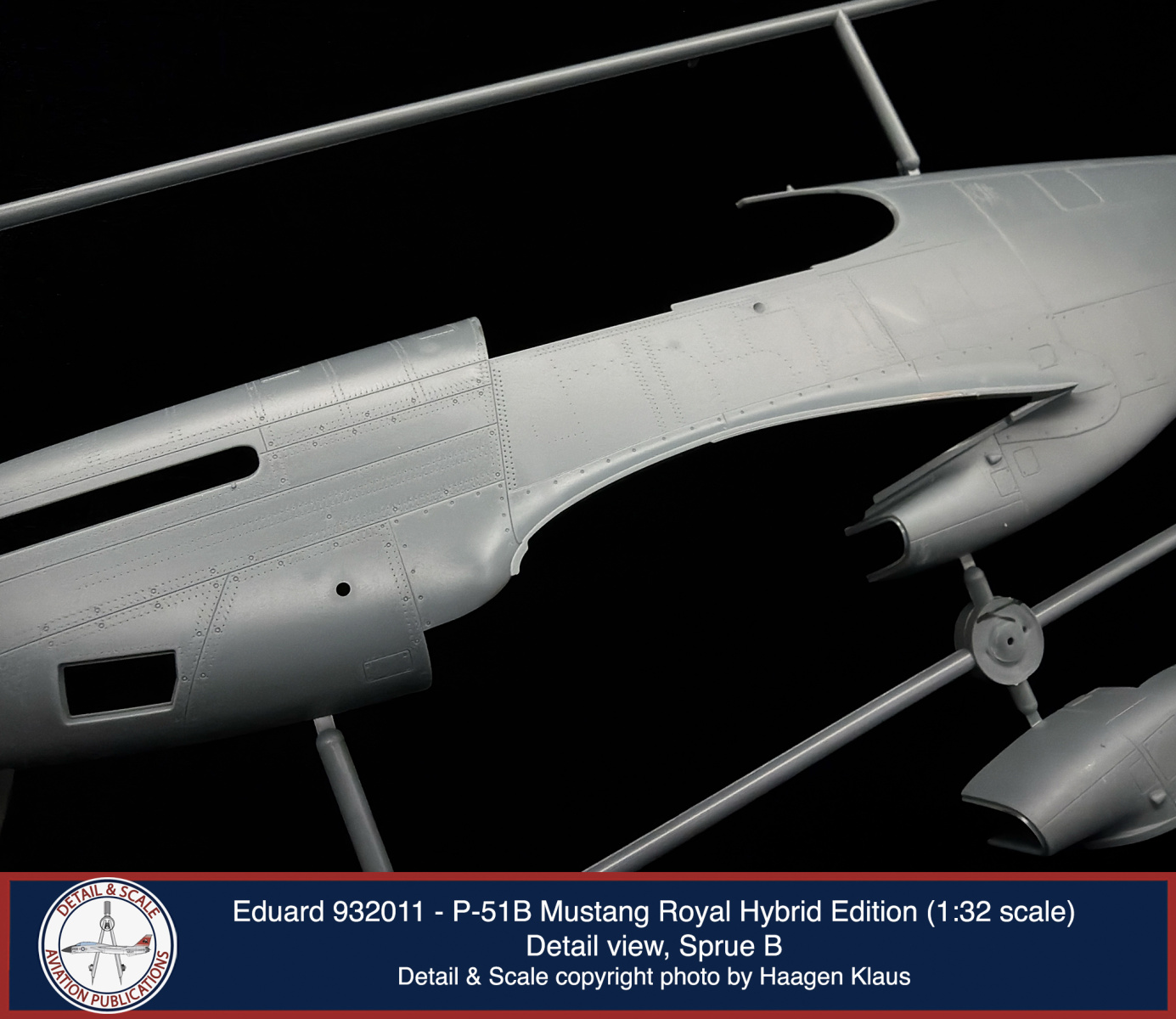
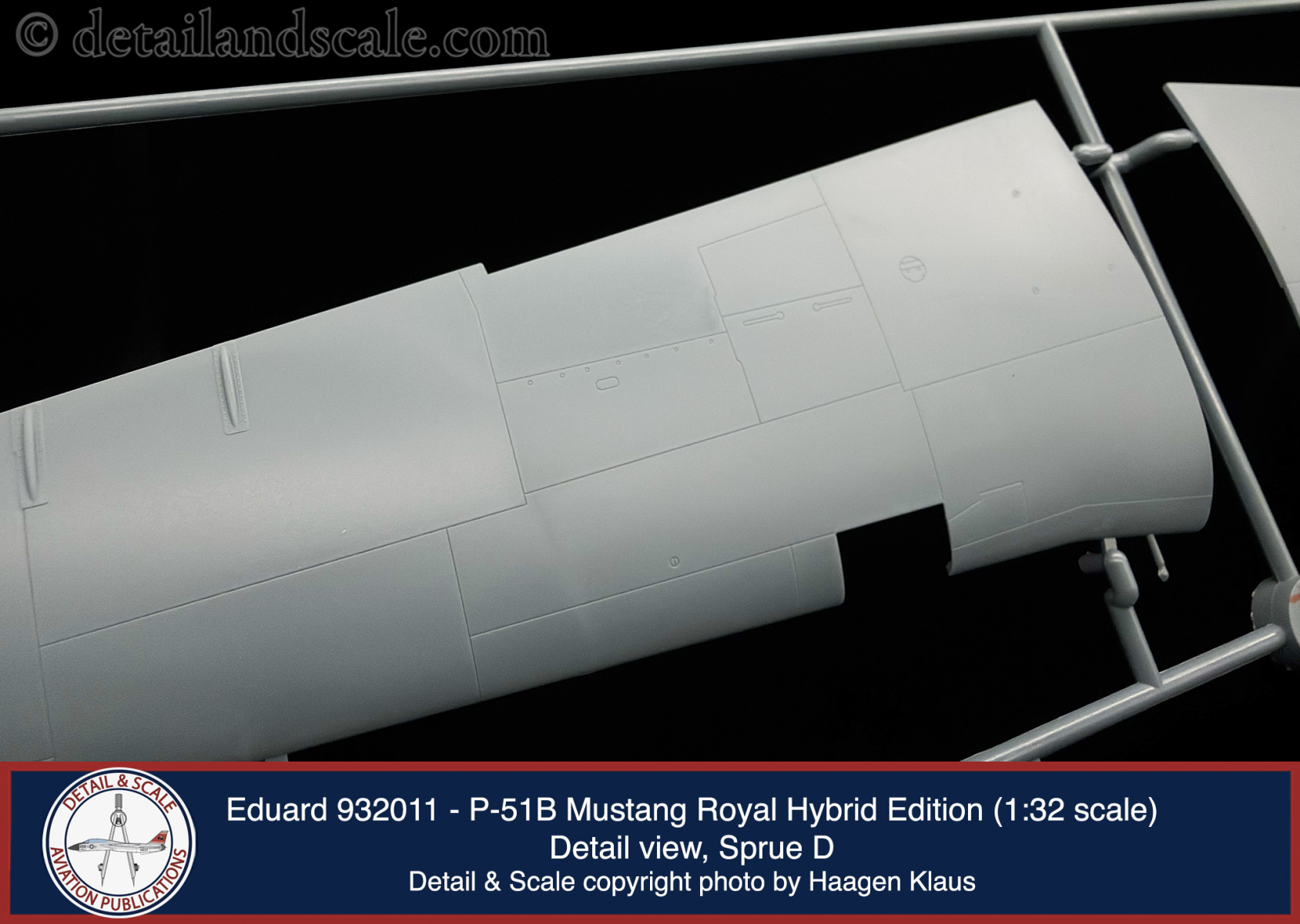
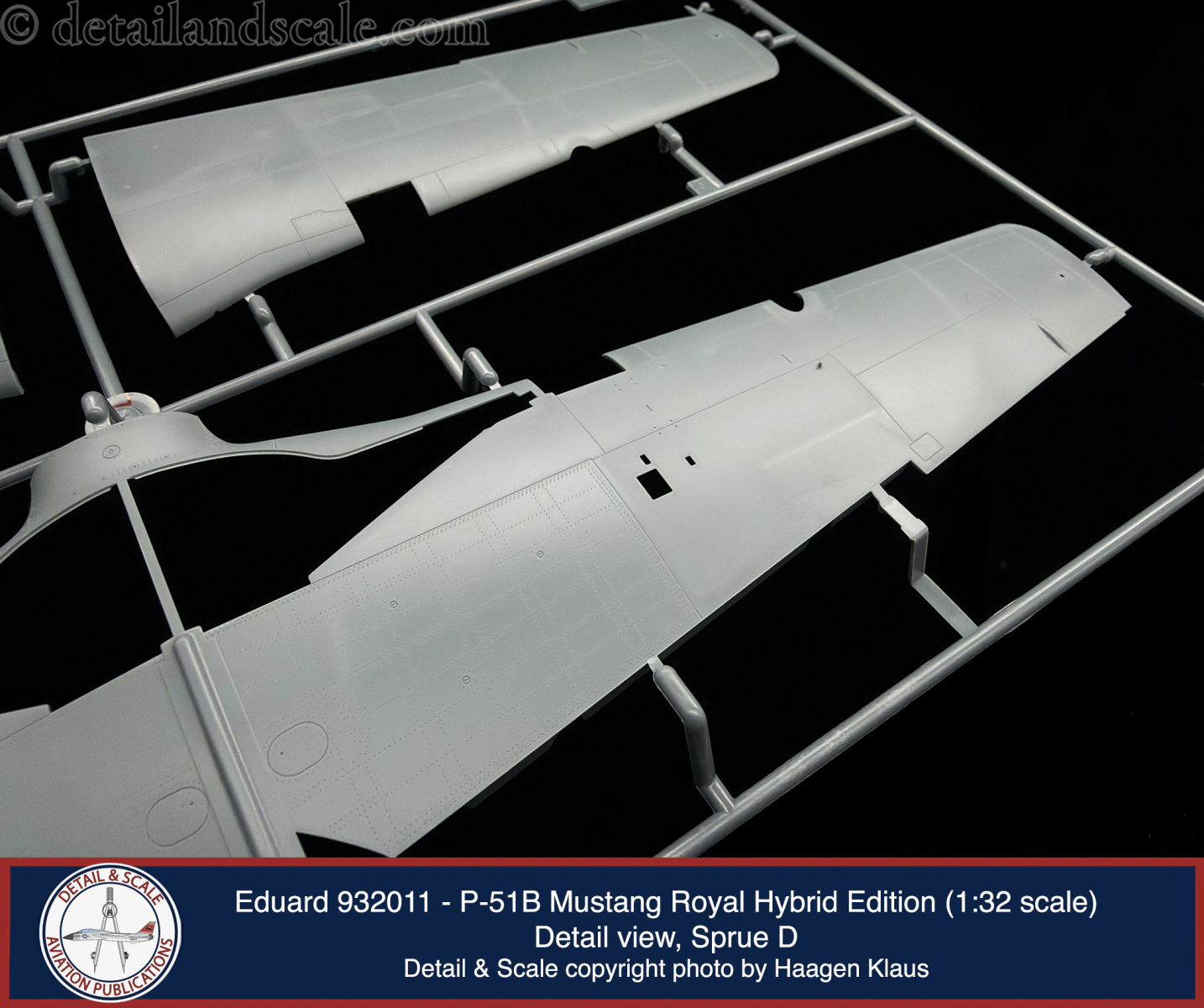
Overall, the plastic parts look great and maintain Eduard’s high standards in molding, with great recessed panel lines, rivets, and fasteners. Of interest to many, the wings have minimal rivet detail identical to their smaller scale Eduard brethren. I dry fit all the major assemblies and fit was predictably excellent. In fact, anyone who is familiar with Eduard’s 1:72nd and 1:48th scale P-51 kits will immediately recognize the same approach to parts breakdown. All the right features appear to be there for the P-51B, and the kit presents an overall high degree of accuracy. At the same time, it also has a degree of welcome simplicity. Having recently built a Tamiya 1:32 scale P-51D, the more straightforward approach to construction here (that is, a notably lower parts count/complexity while supporting a very high level of detail) is really refreshing.
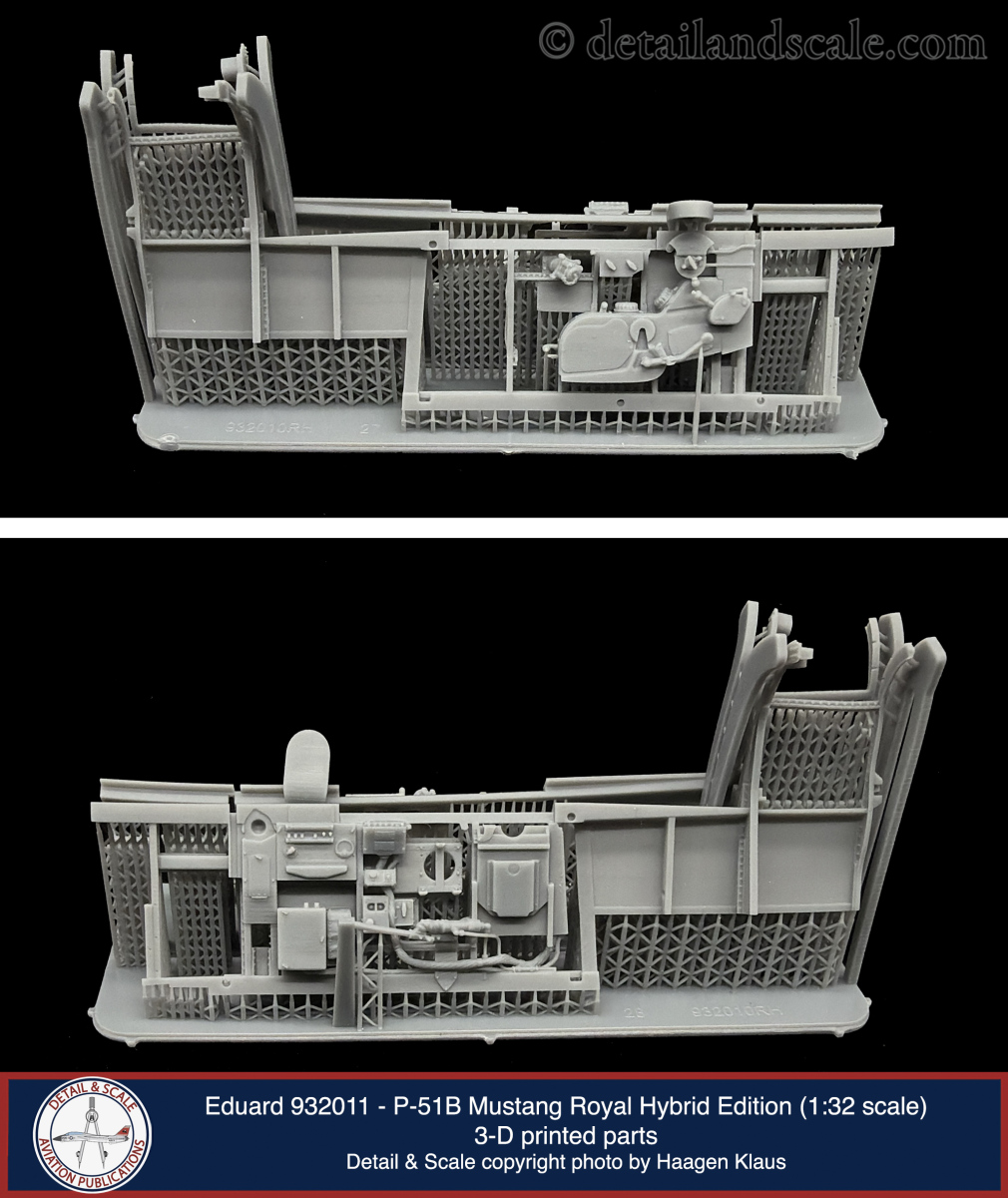
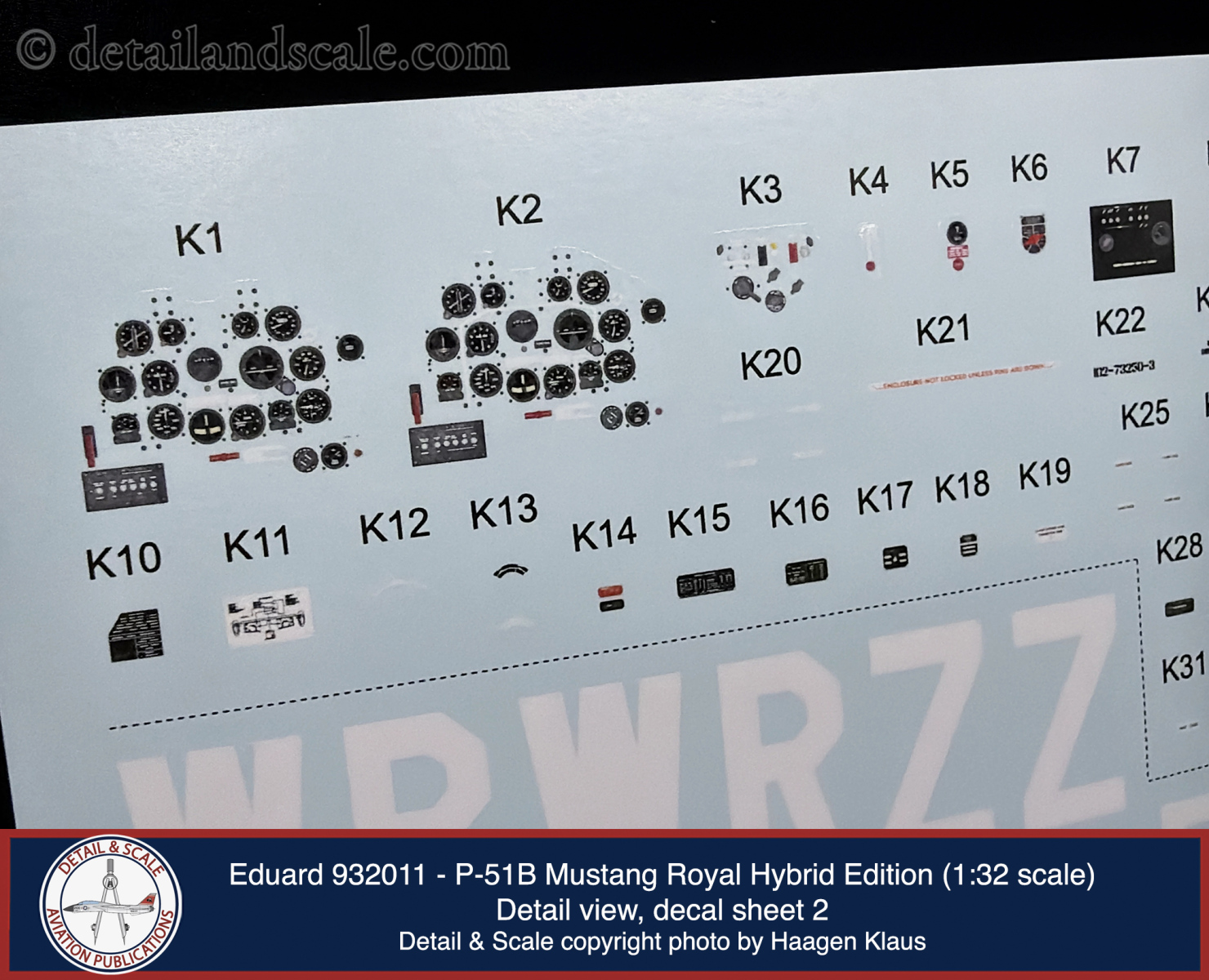
Starting with the cockpit: everything here appears to be 3-D printed. The depth and quality of detail is outstanding, from the cockpit floor, stick, and rudder pedal assembly to beautifully printed and accurate sidewalls. Both Schick-Johnson and Warren McArthur seats are provided. The instrument panel has featureless dial faces, and one must use the kit decals for the details. I’ve done a number of Eduard instrument panels like this and the effect works well, especially when one adds a drop of AK’s Gauzy glass coat or similar gloss agent atop the gauge face after the decal is down and settled. The seatbelts are not photoetched metal, but printed resin, and they are designed to drape very precisely on the seat. The kapok-filled backpad is also a separate part, and the first aid kit pack is nicely represented.
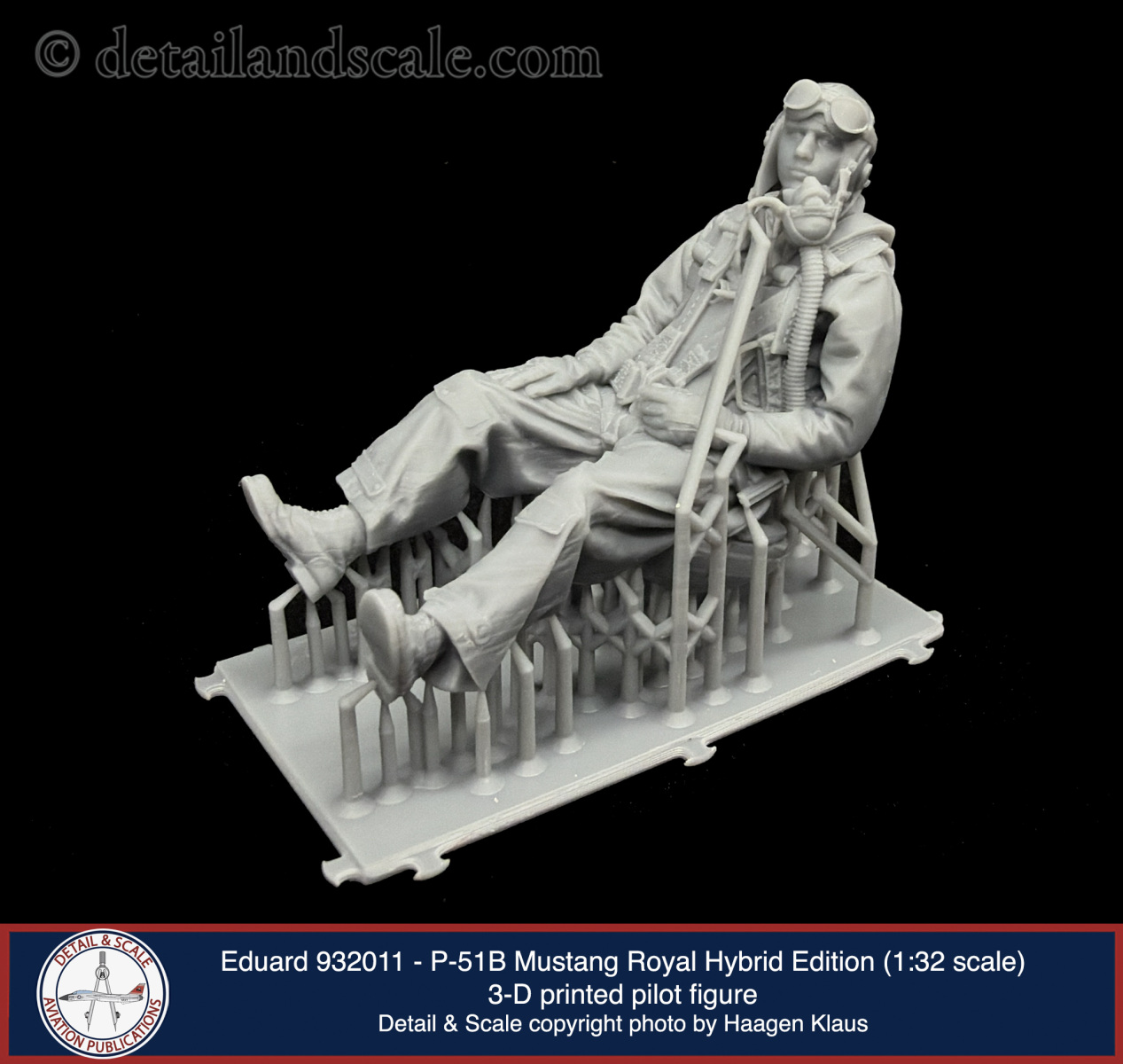
This Royal Edition comes with an exquisite 3-D printed seated pilot and includes a second set of shoulder harnesses and lap belts to fit over him specifically. Two different styles of instrument coaming are provided and include the internal framing for the bullet-resistant center glass of the windscreen, and an optional N-3B, N-3C, and Barr and Stroud Mk. II gun sights. Cockpit sills include those for the standard “birdcage” canopy and the rails upon which the Malcom Hood canopy slid back and forth upon. Aft of the pilot’s seat is the 85-gallon internal fuselage fuel tank atop which sit again a beautifully printed and detailed (including all the wiring) aircraft battery, the P-94A dynamotor, and SCR-522-A radio set.
The clear parts have great optical quality (though see below). The windscreen extends into the upper forward fuselage to make for a clean integration and easy painting of the windscreen. The standard birdcage canopy and Malcom hood both feature parts for either open or closed options.
Exhaust stacks come as 3-D printed parts in both shrouded and unshrouded versions. Three different styles of carburetor air inlet filter panels are also present. The wings feature dropped flaps, only. This is correct for just about any unpowered Mustang sitting on the ground, as the wing flaps dropped when hydraulic pressure bled off. The ailerons, rudder, and elevators are also separate assemblies but are designed to go straight-in, representing them the neutral position. The gun barrels are nicely hollowed out printed parts, and they fit into a wing gun port insert. The landing light in the leading edge of the wing also looks quite good. Underwing stores feature a pair of 75-gallon drop tanks, only.
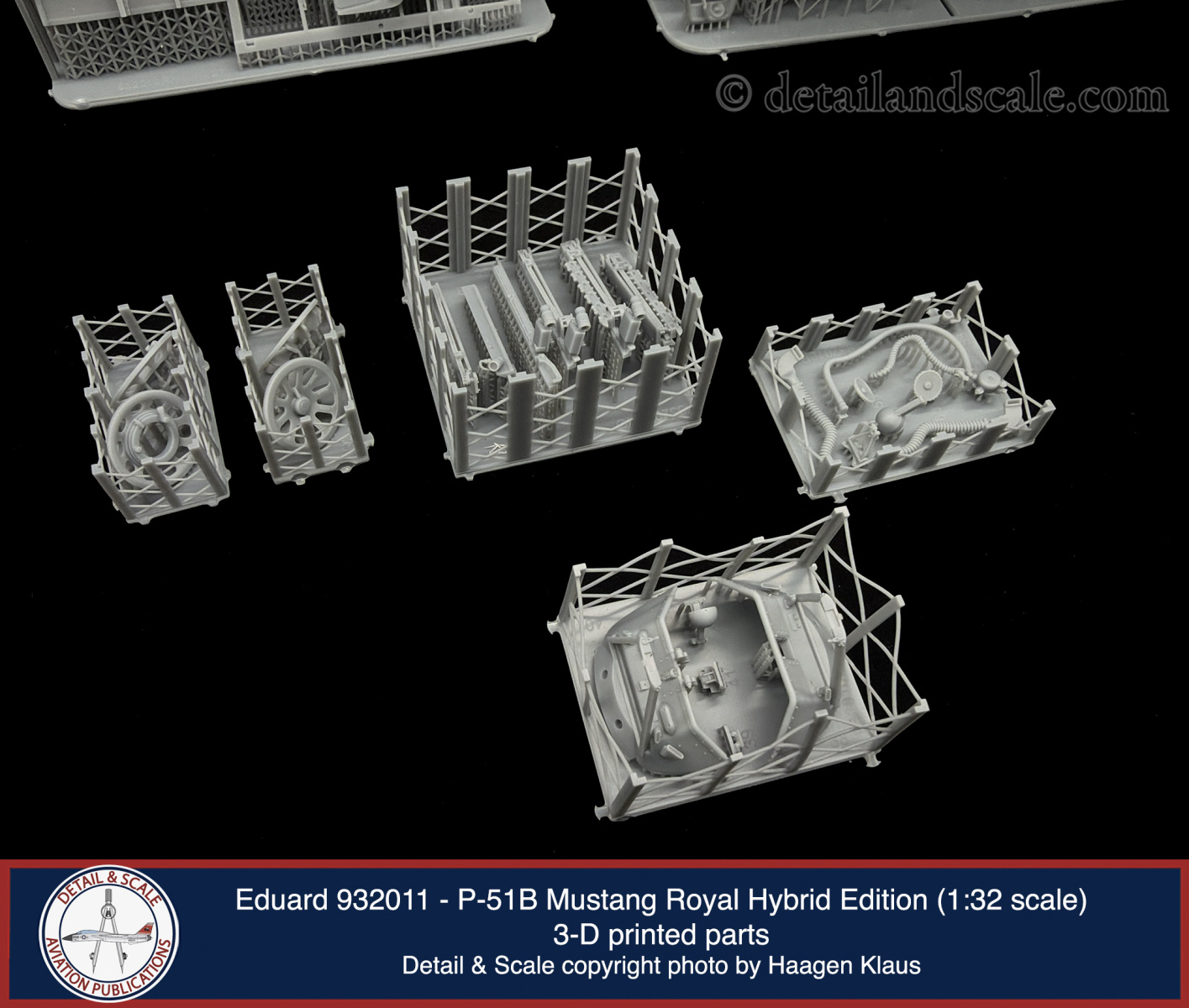
A set of 3-D printed landing gear look great down to their hydraulic lines, but if one is concerned about the long-term weight bearing capacity of these resin gear, the kit also comes with standard injection molded main mounts, thought they have less detail. The 3-D printed main gear wells are another highlight of this kit. The detail is stupendous, and being quite familiar with the aircraft, I can say everything is there, from fuel and coolant lines to hydraulic line tubing, pumps, the hydraulic reservoir, gear uplocks, gear door actuators, and more. Inclusion of the Omask foam gear well masking plug is a thoughtful touch, especially after one will invest so much time in painting all that detail. The tailwheel gear assembly is injection-molded, and two varieties are included: standard tailwheel gear (uncovered), and one with the canvas boot cover. The cast resin main gear wheels have a diamond tire tread while the tailwheel accurately portrays a fine circumferential tread.
The decals come in the form of Eduard’s removable film variety, and anyone who has built an Eduard kit over the last several years is familiar with this type of waterslide decal. The range of markings is awesome and really capture a few of the most iconic P-51Bs that served in the European theater. As always, Eduard does deep-dive research on the markings in all of their kits, and the stories of the airplanes and pilots that accompany each marking options are as detailed as they are humanizing.
The P-51B Royal Hybrid Edition boxing also contains a 112-page book: P-51B/C Mustang: Technical Development, Combat Operations, and Markings Evolution by Jan Zdiarsky, Vladimír Sulc, Michael Krechowski, et al. It is an excellent read covering the developmental history of the airplane and is replete with many historical vignettes of the early Merlin-powered Mustangs in combat. The section on markings is also very informative. Builders will also appreciate the references on Mustang pilot flight gear and the extensive feature at the end involving reference images of the kit detail parts and how to paint them. There are also pages reproduced from the P-51B/C flight manual, other NAA documents, and photorealistic 3-D renderings depicting various configurations of the cockpit, seats, radio sets, and birdcage versus Malcom hood canopy configurations. Of course, we would hope this book would not overlap too much with Detail & Scale’s recent publication on the P-51B/C, and it does not. In fact, I would argue they are highly complementary companion references for the scale modeler.
Weaknesses: There are few critiques to be levied against this kit at this time. From a builder’s perspective, one would hope the top of the engine cowling could be a single piece, but all Eduard Mustangs come together at the centerline. This kit is no different. It makes gluing and sanding of the centerline cowl seam a precarious affair, and the fine rivet and fastener detail is almost certain to be lost. Also, the DZUS fasteners are missing from the cowling centerline panel on the left and right fuselage halves. One may have to wait for other external stores to be released by Eduard beyond the 75-gallon tanks in the kit, but many of the stores in other kits (e.g., Tamiya, Zoukei-mura, or Revell P-51Ds) could be adapted here.
When viewed in cross-section, the Malcom hood canopy is not quite right, and does not achieve the “blown” look and correct teardrop geometry. The Malcom hood does not balloon past the width of the cockpit sills and possesses a wide C-shape curvature in cross section. This is a common problem in many P-51B kits.
There are fewer construction options than some might wish for, beyond the fixed-position control surfaces. Eduard’s kit design purposefully captures an “average” P-51B/C. Note that early production blocks preceding the P-51B-15 and P-51C-5 cannot be build out-of-the-box from this kit. It must be built with the fuselage tank installed and with the parallel radio/battery arrangement. It is also not feasible to build from this kit any P-51B/C with the dorsal tail fillet. This was a kit sent to forces in the field that was added to the forward base of the vertical stabilizer to improve stability. They were relatively rare in P-51Bs but more common among P-51Cs. There are at least hints that future releases might have alternate parts for early block aircraft without the fuselage fuel tank.
One technical consideration: the instructions show installation of the main (inboard) gear doors in the open position. In the P-51B/C, the main gear doors only cycled open during the gear retraction/extension sequence. Under all other conditions on the ground, they were typically retracted and closed. This is a common error in the P-51 scale modeling world among both builders and manufacturers. It is a shame to obscure some of that great detail in the main gear wells, but an accurate configuration should have the doors closed.

Eduard has launched their 1:32nd scale Hybrid product line with a rather impressive P-51B kit. The only real shortcoming is the shape of the Malcom hood canopy. As the price of 3-D printing continues to go down and its quality increases, one can see how this “hybrid” approach could catch on across multiple manufacturers. Eduard may be at the vanguard of something big. One thing is for certain: the combination of injection-molded and 3-D printed parts works exceptionally well in this kit. I cannot wait to build it. Eduard has already started to release a few extras for their 1:32nd P-51B, such as a gun bay detail set and TFACE masking sets.
Also, if you want this Royal Editon kit and haven’t gotten it yet, Eduard is planning a final production run in the late summer of 2026- and that’s it. More P-51B releases will come, but they will not contain the same markings, pilot figure, and book. Eduard receives a sincere “bravo-zulu” for producing by far and away the best P-51B in 1:32nd scale. The outstanding 3-D parts truly elevate the level of detail. We may entertain the judgement that this is the best early Mustang kit in any scale to date.
You can visit Eduard on the web at http://www.eduard.com and on Facebook at https://www.facebook.com/EduardCompany.
Haagen Klaus
Scale Modeling News & Reviews Editor
Detail & Scale